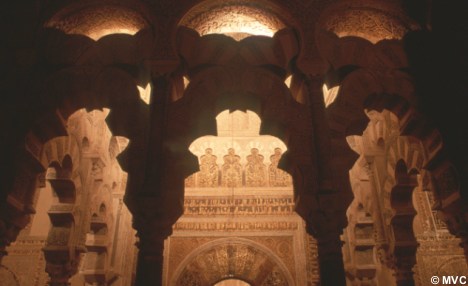
Incongruously, the "mosque" contains a Christian church © Michelle Chaplow |
|
The Cordoba Mosque - History
by Lawrence Boheme
The most striking thing about the Mezquita is that, incongruously, the "mosque" contains a Christian church (Cordoba's cathedral). What one sees from outside is confusing indeed: a huge, flat-roofed low-lying square building with a gigantic baroque church jutting up in the middle like a rather unsightly stone wedding-cake.
But before joining the politically-correct chorus which loves to bemoan this Christian crime against Moorish art (which, undoubtedly, it is), consider the chequered and equally "criminal" past of this sacred site from the very beginning. It will also give you an idea of Cordoba's key role in Spanish history.
First, the Romans built a pagan temple on the site. After the fall of the Roman Empire, the new Germanic masters of Spain (the Visigoths) replaced it with the Christian church of Saint Vincent. When the Arabs conquered the peninsula in the early 8th century, they tore down the church and began building their great mosque, which - commensurate with Cordoba's importance as the centre of Muslim power in Spain - became the largest mosque in all of Islam after that of Caaba, in Arabia.
When the Christians re-conquered Cordoba in 1236, they did with the mosque what they did in all of the cities of Andalucia - instead of bothering to build a new church, they simply "converted" the building to Christianity and set up an altar in the middle. In the 16th century, this modest gothic insert was enlarged and given its current Renaissance - and later, baroque - styles, resulting in the strange hybrid which we now see, with its ornately carved altar and pews (the choir is distinguished by the fact that it was built entirely in mahogany brought from America).
Guided tours in Mosque / Cathedral of Córdoba city
Book guided tours in Mosque / Cathedral of Córdoba city
Private Guided tours in Mosque / Cathedral of Córdoba city
Book private guided tours in Mosque / Cathedral of Córdoba city
The original mosque was permeated all around with open arches, so that the sunlight could flood in, leading the worshipper to the shadows of the central area, to represent his mystical journey towards Allah; but the Christians, being less inclined towards letting in the natural elements, plugged up most of the openings so that they could be used as a backdrop for chapels dedicated to the various saints. The minaret was left standing in the middle of the west wall, but did not fare as well as Seville's Giralda, which was simply capped with a bell-tower: it was used as the central core of a new baroque sheath (as you climb up inside it, you see the sealed-up arches and windows of the Moorish original- a tower within a tower).
As in Seville, the Patio de los Naranjos (Courtyard of the Orange Trees) has survived, and it was here that the worshippers washed at the fountain before entering the mosque. But all the other mosque-churches which were created in Andalucia - including the cathedrals of Seville and Granada - were eventually torn down in the baroque period to make way for "real" churches. The Cordoba contraption was only spared because the people of the city, even in those intolerant times, were aware of its special grandeur and beauty. An indication of this grass-roots affection for the great edifice is still alive today: the people of Cordoba do not say "I went to Mass at the Cathedral", but "I went to Mass at the Mosque". It is a contradiction which could only seem "natural" in Spain.
The mosque was begun at the end of the 8th century and completed 200 years later, in four distinct phases, the last and largest of which (the north side) was carried out by the legendary military leader Al-Mansur. This means that the original 8th century building was only about 20% of its current size. Embedded in the inner side of the eastern wall (the one closest to the river) is a sort of octagonal chapel surrounded with high, arched windows, and richly adorned with mosaics: this is the mihrab, a key element in all mosques which indicated the direction of Mecca.
The most distinctive feature of the Mezquita is the forest of columns which supports the roof, but they, like so many other things, were taken from somewhere else - in this case, from the Church of Saint Vincent which had previously occupied the site; others came from Roman and Visigothic homes in the city, and when these ran out, the Arabs made their own. But the columns were for the most part only seven or eight feet high, which meant that the huge ceiling would be aesthetically too low. So the Moors brilliantly invented a double-tiered column-and-arch construction, which made it possible to increase the height of the central parts of the temple without cutting off the daylight.