
This mountain village, on of the most isolated in the region. It lies a long and windy 11km from the A376 San Pedro-Ronda road, beyond the pueblo of Igualeja. With a 4x4 or taking it slowly, a basic 'Jubrique track' leads over the mountains from the Estepona - Jubrique road. It can also be reached via another track from Juzcar and across the Rio Genal. Trout fishing is popular here but by permit only. This is also the site of the deserted medieval village of Cenay, which was large enough to have its own church and was the seat of a very large rural parish.
The municipal district is a very mountainous area, with the only fertile land leading down to the river Genal. The Rio Guadalmansa's source is in the southern half of the municipality, cutting a deep valley through the mountains before reaching the sea between near Cancelada between San Pedro and Estepona. This geographic feature is nowadays known only to locals, but during the pre-industrial age was a major route to the coast.
The village sits at the end of a paved road (MA 7300) from Igualeja, although a newly paved road that is not shown on many maps, now winds out of the back of the village (GPS 36* 36' 44"N 5* 9' 6"W Google maps) through the chestnut forests back to the San Pedro-Ronda road, a vital factor in its continuing survival.
A small Ermita de San Antonio (GPS 36* 36' 56"N 5* 8' 13") can be seen on the approach to the village (from Igualeja). This is at an interesting spot as it overlooks a deserted medieval community. Located in the grounds of Cortijo Bentomi by La Fuente de Bentomi, this is the only visible evidence that this was the site of the lost village of Benatamin (Banu Tamin). Sometimes referred to as Benicarni, it had a population of 59 in 1492 but disappeared from records in 1501. It seems that Pujerra absorbed the community for administrative purposes. There are now municipal Apartamentos Turisticos, a signed circular 750m forest walk, picnic tables and locked toilets here as well.

Park your car at the village entrance by the 'paseo' and walk past the fountain along Calle Fuente and consult one of the useful ceramic street plans. As with other pueblos blancos, visitors should aim for the main Plaza. This is where the parish church, the only building of note, can be found. The small 16th century Church of Espirito Santo is a single nave building with a square tower, which would have been founded as a chapel, served by the priests of Cenay. Remodelled in the 18th century, it acquired various additions, including the top of the tower, with a two-sided addition atop. The church is reminiscent of simple hermitage chapels found throughout the area. It contains many images from the 17th-19th century.
Oddly, many of its white stone houses have typically Arabic tiled roofs, alongside tiles bearing Greek Christian symbols taken from 11th Century Christian tombs. Clearly the people of Pujerra believe in seriously hedging their bets.
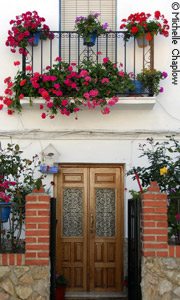 |
| Quaint dwellings in Pujerra |
It is impossible to escape the chestnuts here. With chestnut trees as far as the eye can see in every direction, it would be astonishing if they did not feature heavily in the village's economy. And, of course, they do. They even have their own fiesta each November, when the smell of roasting chestnuts seeps enticingly into every corner of Pujerra before floating out of the village and across the mountain. In the same month, a second fiesta is held to honour the Virgen de Fátima. The only other saint to be so honoured is the ubiquitous Anthony of Padua, a veritable superstar among saints to most Andalucíans. He gets his festival in June.
Pujerra's relative isolation has left it a legacy of quite striking individuality, not least in the realms of gastronomy and music. Music, indeed, comes second only to the almighty chestnut as a badge of local pride. The village is said to have more top class traditional Bandas de Música than anywhere else in the Serranía de Ronda. Neither is that all. There is one venerable but still frequently performed folk dance, known as los fandangos de Pujerra, which is unique to the village, and found nowhere else.
As for the distinctive dishes of Pujerra, probably the best place to sample its idiosyncratic mountain cuisine is at the Mesón Buxarra, a restaurant in calle La Toma, in the heart of the village. Whether you stop by merely for a drink and a tapa, or stay for a full meal, you are unlikely to be disappointed as long as you don't mind being stared as though you have come from outer space by the old men propping up the bar. The atmosphere and the decoration are each as satisfyingly rustic as the fine, no nonsense food. The dandy posturing of nouvelle cuisine seems a galaxy away, and long may it remain so. More recently opened on Calle Fuente is restaurante Casa Benito and Posada Fray Leopoldo.
