
Ronda is one of the most beautiful towns in Andalucia. |
|
Main sites in Ronda
Ronda is one of Andalucia's loveliest towns, steeped in history. There is plenty to see beyond the view from the bridge over the plunging gorge which divides the town. Below are the main attractions and things to see in Ronda, and when is best to see them.
The hermitage is located in the Plaza de la Oscuridad, in the rear courtyard of a house owned for years by the Ponce de León family. Thanks to a scheme by the City Council, and with the… More →
This ninth-century cave hermitage, carved into the rock face, has remained hidden from visitors until recently. Today, it is still used for religious purposes by the Brotherhood of the Virgen de… More →
The area of wine production known as the Serrania de Ronda forms part of the DO Sierras of Malaga, producing what are popularly known as 'the Ronda Wines'. Here modern bodegas at over 750m… More →
The ruins of this 32 hectare city are located at 1.000m above sea level. This is an urban are that thrived in the first century AD when it had a population of 5.000. It was mentioned in Plini and… More →
Inaugurated in 1785, Ronda's Plaza de Toros is one of the oldest in Spain, younger and smaller than that at Sevilla, but home to one of Spain's most famous 'schools' of bullfighting, on foot… More →
Towering above the Almocábar gate, the monolithic church of the Holy Spirit is the Ciudad's unofficial cathedral, and certainly the place where the señoritos and their ladies from Ronda's old… More →
Built on Arabic foundations at the instigation of the Reyes Catolicos after the fall of Ronda in 1485, this imposing structure on the far side of the Puente Nuevo has been rebuilt over the… More →
With views overlooking al Tajo and surrounded by nature, Hotel Catalonia Reina Victoria offers all the comfort and modern amenities of a 4 star hotel. A little to the south of the Alameda, and… More →
The Casa del Rey Moro is to some extent a fraud, since the house was never the home of the Moorish King. It was built in the 18th Century, when Moorish Spain was already a distant memory. Its… More →
Built in the 16th century, possibly on remnants of an earlier bridge, this was the one navigable link between Mercadillo and La Ciudad until the completion of the Puente Nuevo centuries later.… More →
Across the cuesta from the Casa del Rey Moro, the Palacio of the Marqués de Salvatierra family opens irregularly as a small museum of Renaissance art and artefacts. The Palacio is an 18th century… More →
Sometimes called the Roman bridge, as it was thought to have been built on the foundations of an earlier Roman bridge, this was promptly abandoned when the 16th century expansion of the Mercadillo… More →
Reached by rudimentary steps from the Puente Viejo below the Salvatierra palacio, these are said to be one of the best surviving examples of original Arabic hammams, water baths, in Spain. Built… More →
The Paseo Hemingway leads on to Ronda's great green lung, the 19th century Alameda del Tajo. Originally named the Alameda de San Carlos, this is the front garden for a town where nobody has a… More →
Walk up the hill from the bullring, and you will soon find yourself at the foot of a wide flight of stone steps leading to the imposing wooden doors of the Merced Carmelite Convent. The first… More →
Ronda's extensive walls, murallas, were begun by its Moorish rulers in the 13th century, renovated in the 16th by the Christians the earlier walls were built to keep out, and parts are still being… More →
By far the loveliest public space in Ronda, this leafy square boasts an embarrassment of monuments. Its star is the Iglesia de Santa Maria del Mayor, whose exquisite belltower suggests Renaissance… More →
Behind the Plaza de Toros are Ronda's spectacular walkways celebrating two famous visitors, the Paseos de Ernest Hemingway and Orson Welles, both great aficionados of the corrida and just two of… More →
Ronda's loveliest enclosed space is the Mondragón palace, the heavily renovated and part-modernised remnants of what once was the palace of the Moorish ruler Abbel Mallek, or Abomelic, son of the… More →
Ronda is divided into three parts, and the old Moorish citadel, La Ciudad, should be explored first. If, like most visitors, you drive up from the coast, the first part of town you will encounter… More →
The building known as the Casino and Circulo de Artistas (Artists Society) is located on the north side of Ronda's Plaza del Socorro. This is a charming corner of the town where tourists enjoy… More →
Puente Nuevo, Ronda's 'new bridge' was completed in 1793, after 40 years in construction and after the loss of the lives of 50 builders constructing the span bridging the 98m Tajo gorge. The… More →
Ronda Municipal Museum contains an interesting selection of artefacts and artwork from the history and culture of Ronda.
The museum is which opened in 2021 dedicated to dedicated to the artist Joaquín Peinado (Ronda 1898 - Paris 1975. It is dedicated to his memory and his work work. The museum is located in the… More →
Ronda Guided City Tour
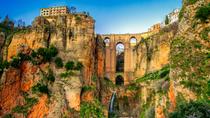
Discover the unique heritage of the beautiful city of Ronda that nestled nestles either side of the Tajo (Gorge) which divides it. From the Puente Nuevo (New Bridge), which serves as a connection between the old medina and the new medina, you'll see beautiful views. 
Ronda: Tapas and Wine Tasting Tour
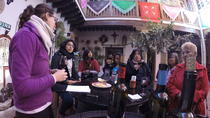
Explore the town of Ronda like on a food and wine tasting tour, and see all the best spots of the city while enjoying some of the finest wines and delicious tapas. Visit the Ronda Wine Museum and learn more about the region's wines Taste the wines of this Malaga wine region at the Ronda Wine Museum. See the famous sights of Ronda with a local guide and visit local gourmet shops and restaurants.
Ronda Half-Day Tour With Tapas
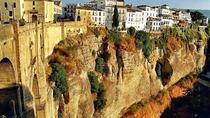
The incomparable phenomenon of Ronda, separated by the narrow and deep gorge. The spectacle of Ronda is indescribable, and, around it, an ample valley with working fields, oaks and olive trees. And there in the distance, as if it had recovered all its strength, the pure mountain rises, range after range, until it forms the most splendid background.
Private Walking Tour of Ronda
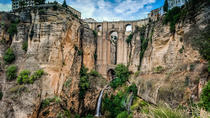
Discover the beauty of Ronda on this private 3-hour walking tour. Enjoy this personalized tour with an official tour guide. Explore the city's most iconic monuments and sights like the Arab baths, Old Town Hall, and one of Spain's oldest bullring. You can customize the tour to meet your needs.
