 Sunflowers are harvested in Castellar
Castellar de la Frontera
Take me to: Castellar Hotels
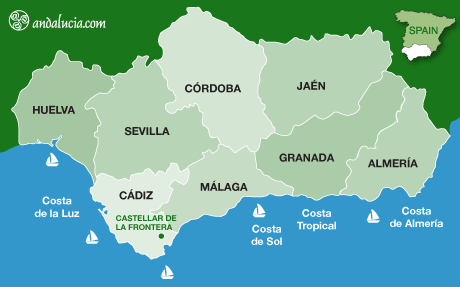
The old village of Castellar de la Frontera or Castillo de Castellar is perched high on a hilltop in the province of Cádiz, offering commanding views over the Guadarranque reservoir. It is most easily reached from the A-405 road, which leaves the coast at San Roque and branches off towards Castellar (CA-P-5131) after just 10 kilometres. This historic fortress village is famous for its castle — the word 'Castellar' literally meaning 'site of the castle'.
Evidence of the area's prehistoric past can be seen in the many caves, which contain wonderful cave drawings that serve as proof of the region's heritage. The history of the old village dates back to the late Moorish period, when the medieval fortress was built. The fortress played an important role in the Catholic reconquest of Moorish Iberia. Due to its advantageous strategic position, both sides wanted to control this strong vantage point.
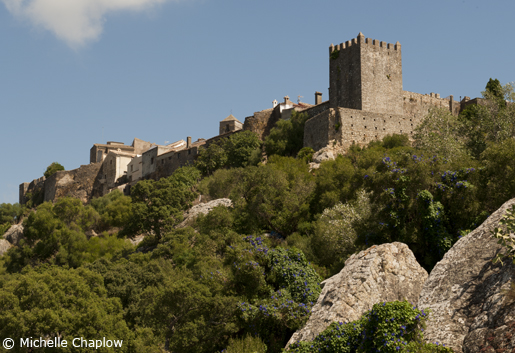 |
| The old village of Castellar de la Frontera is perched high on a hilltop. |
Juan de Saavedra conquered the fortress in 1434 on behalf of Fernando III and the Crown of Castile. Juan described it as 'such a wonderful, strong town'. Following many battles during the medieval period, Teresa María Arias de Saavedra, Countess of Castellar, took possession of the town in October 1650, after which it passed into the hands of the Medinaceli family.
In the 1960s a new town was built 7km away in a more convenient location next to the road and the train station known as Almoraima. The new model Andalucian town was inaugurated in 1971.
Two years later, the Rumasa Group acquired the old village, the convent and the La Almoraima estate. In 1983, the Spanish government expropriated Castellar and declared it a 'historical and artistic monument'. By this time, the fortress was in a state of neglect and abandonment, but the town hall invested in restoring the old castle structure.
Much of the area within the municipality of Castellar is now a part of the Parque Natural Los Acornocales.
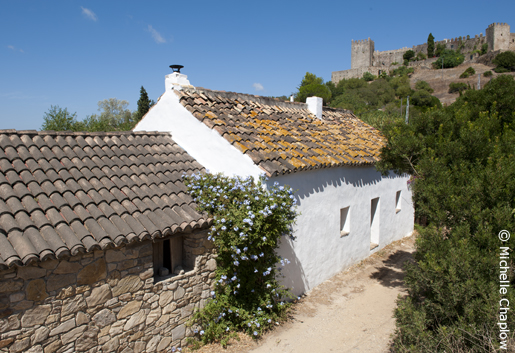 |
| Quaint village streets of Castellar. |
After the remaining inhabitants of the old town were rehoused in Nuevo Castellar, a town with modern amenities, the old town became a hippy colony. Bohemian people still live there today. Following extensive restoration work, it has become a tourist town. There is a nine bedroom Hotel Tugasa Castillo de Castellar built into the Castle walls. The are many village houses for rent. There are as well as shops, bars and restaurants.
There is a market at the entrance to the village every afternoon / evening in the summer. It is certainly worth a visit.
You can drive all the way to the castle, but it is advisable to park in one of the designated car parks and walk the up last few hundred metres to the castle gates.
 |
| Hippy markets in Castellar. |
La Almoraima Estate
The La Almoraima estate, located in Castellar de la Frontera, covers an area of 14,000 hectares, making it one of the largest in Spain. The main industries are agriculture, forestry, cork production, hunting and tourism. A large quantity of cork is produced from the oak trees, which are stripped of bark every seven years. Ninety per cent of the estate lies within the Los Alcornocales Natural Park. The estate has an interesting history, having been expropriated by the state in 1983.. More>
New Castellar
New Castellar, a model new town, inaugurated in December 1971, with its well-appointed modern houses, wide streets and avenues and open green zones, is quite a contrast to the old town. The inhabitants of the old town were pleased to move into these new living conditions, since the old mountain village houses lacked all the 'mod cons' we tend to take for granted. The striking new white houses are distinctive against the green of the well-tended gardens. The town's inhabitants are also proud of their heritage, which is being preserved in the mountain castle village.
Nuevo Castillar is now simply called Castillar and the Castle sits on top of the hill outside the village. Although modern it is interesting to visit. Plaza de Andalucia in the centre with is planted areas, fountains, sculptures and a church bell tower that looks like the year it was built. There are a number of bars and cafes and mini supermarkets.
The convenient modern Hotel Castillar, located on the outside of town near the Aloraima Railway Station is well worth a stay to enjoy the relaxing patios where meals are served. The more tradition Almoraima Hotel is also very good value.
Festivals in Castellar de la Frontera
- The fiesta of "La Boyal" day - 15th February. The town celebrates the day that the people took back land, which previously belonged to La Almoraima.
- Semana Santa (Easter Holy Week)
- The Romería and annual fair celebrating the Holy Christ of La Almoraima takes place on the first Sunday in May. There are days of festivities leading up to it, including dancing. The Sunday Romeria and procession used to be called 'el Domingo de los Ingleses' (Sunday of the English people) because of the large number of Gibraltarians who came to take part in the celebrations.
- In July there is an important Flamenco Festival.
- The Evening of the Divino Salvador takes place on the first weekend in August. There is flamenco singing and traditional dancing, as well as other events organised at Castellar Castle, to celebrate the San Salvador festival, which honours the town's patron saint.
Hotels in old and new Castellar
Hotels in old and new Castellar