Driving towards Yunquera from either Ronda or Málaga, it is not apparent that this village sits on an impressive cliff top, protecting two sides of the pueblo. It's best to park on the outskirts of the village and walk in, as access is limited. A good spot to start is on the crossroads by the Hermitage of the Cruz del Pobre. Dedicated to the poor and established in the early part of the 18th century, it is only 10m high on a floor-plan of 25x10m. Split into two small naves with a modern altar decorated with plant designs, this was probably used by travellers on their tortuous journey from Málaga to Ronda. There's a friendly bar at the side of the hermitage, with an outside terrace facing the busy main road.
Nuestra Senora de la Encarnacion
Walking into the village along Calle Málaga, the land still bears the evidence of terracing. The ribbon development over the last 150 years has followed the old Málaga road, hemmed in on the left by steep cliffs. Having reached the main plaza, head for the parish church of Nuestra Senora de la Encarnacion, as this is the centre of the original pueblo. The original church was the re-dedicated mosque but this was remodelled between 1603 and 1615 under the master mason of Málaga Cathedral. However, the church was virtually re-built on the plan of a cross at the end of the 18th century. Though not acknowledged, this was probably as a result of the earthquake of 1755 that partially destroyed the castle in neighbouring El Burgo. The tower, to the right of the building, stands on earlier foundations that may be the only part of the mosque that survives today. The church is divided into three naves, supported by ten columns, with a false plaster dome at the end. There are two other side entrances to the large church, one of which leads to the priest's house.Moorish Aqueduct
The area between the church and the cliff was the site of the Castillo that was deliberately destroyed towards the end of the 16th century. This was done so that it could not be used as a bastion for the Morisco uprisings of the time. Evidence is hard to find from within the buildings, but from the end of Calle Agua (see below), some of the old castle walls and fortifications can be seen, incorporated into later buildings.
Extensive Moorish remains can be seen at the bottom of Calle Agua. As the road name suggests, this leads to the source of the town's greatest asset, water. The road can be taken by car, though it drops rapidly down a very tight Z bend. Keep going until the road passes through a double stone archway. Known as Puente Palo, this is not a fortification but a good example of a Moorish aqueduct system, still carrying water today. Pass under the arches and a car park can be found on the right of the track, enabling the visitor to absorb this hidden corner of medieval engineering.
The start of the aqueduct can be seen from the other side of the car park, as it harnesses the water from a spring further upstream. Keeping the water at a sufficient height, the water crosses the road via its twin arches before it enters a vertical chute, by an old building that was once a working mill. This provided sufficient power to drive a wheel that was used to grind corn, olives and, later, cork. The flow of water can be seen leaving the area, being reused for mills lower down the slopes and for extensive irrigation purposes among the complex terracing. This shows how a large village in a mountainous zone was able, with intensive farming, to support a large population during the Moorish period.
Take the concrete track over the small bridge and observe the deep cut gorge. The flow of winter waters off the mountains can be torrential, so much so that the ruins of an earlier packhorse bridge can be seen. Dropping down about 100 metres past the mill, the full extent of the village's cliff-top location can be appreciated, it is only now that the pueblo's defensive properties can be admired and many of the old castle and town walls seen. There is an interesting return along Calle Agua.
Ermita de Nuestra Senora Carmen de Porticate
Moving back to the edge of the village, you will pass Ermita de Nuestra Senora Carmen de Porticate. Built in 1799 with an endowment of 399 maravedíes and dedicated to Our Lady, it is the only place left that reminds the visitor of the nearby deserted medieval village of Porticate. The church had fallen into disrepair but was heavily restored in 1929. Today it stands as a simple rectangle church with a wooden ceiling.Torre Vigia
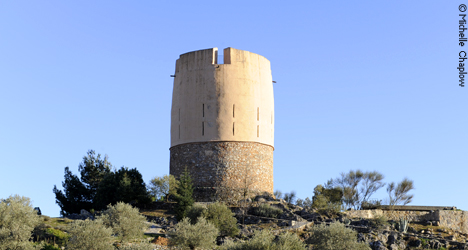
Dominating the pueblo from the higher ground, this fortification can be found just outside the town on the Ronda road. This was not the main castle since the castle was in the village and was destroyed in 1598. Though often referred to as the "Moorish Tower", much of the original fabric was destroyed by the retreating French in the Peninsular War. The tower was virtually reconstructed in 1813, under the orders of General Balintino after the withdrawal of the French, as a signal station. Built in two stories, the lower one contained emergency stores while the upper level was used for observation and protection. Today it has been heavily restored and is an information centre, published hours are Tue to Sun 10.00 to 14.00 and Fri & Sat 17.00 to 19.00. It does, however, offer views of the village and the valley below.
Yunquera Astronomic Observatory
The Yunquera Astronomic Observatory is located on top of the Torre de Yunquera at 730m altitude. Since 2010 the observatory has been a place for astronomers to studied the night sky with digital cameras. The proximity of the natural park reduces the light pollution. The observatory is also equipped with a Schmidt Cassegrain 25cm telescope and CCD double sensor refrigerated camera. It is semi automatic permitting remote control by internet. The international code for the observatory is MPC CODE I65 from the MINOR PLANET CENTER, of the International Astronomic Union. The observatory welcomes interest from the general public and conducts regular talks, exhibitions, and workshops. Location is 36º 44' 12.4" N and 4º 55' 17.3" W website http://www.observatorioyunquera.es
Ermita Mora
Looking towards the village and only 75 metres from the tower on the other side of the track stands an old brick ruin. This was a Moorish shrine, though in a poor state of repair. Surrounded by a fence, the only evidence of its past is a half moon crescent that can still be seen over the door. Local legend suggests that a tunnel led from here to the tower, though this is highly unlikely, as a deep track divides the two locations. How a Moorish relic survived the ethnic cleansing is hard to understand. It can only be presumed that the site was taken over as a Christian hermitage church, which in later times became a ruin in its own right.