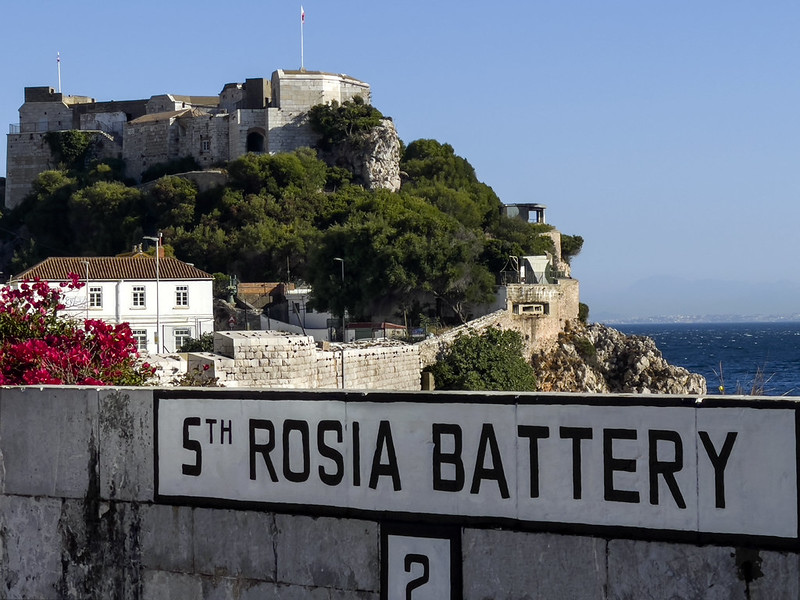
 Parsons Lodge © VisitGibraltar.gi
Self-Guided Walking Tours in Gibraltar
Travelling on a budget? Looking to get your steps in? Enjoying the beautiful weather? Explore Gibraltar at your own pace with our curated self-guided walking tours. Whether you're a history enthusiast, wildlife lover, or looking for a challenging hike, each route highlights the very best of the majestic Rock from Moorish fortifications and iconic wildlife to panoramic viewpoints in the Upper Rock Nature Reserve. Choose your trail and start your adventure whenever you’re ready!
By Haylee Pincho
For the History Buffs - From Fortress to Summit
1. Grand Casemates Square
Starting from Casemates square gives you a perfect view of upper town and you can explore the old town upon your ascent. Grand Casemates Square was named after the bomb barracks completed in 1817 by the British under Governor Sir George Don. During the Moorish era (1160-) the square was used as an intertidal zone to beach their galleys, sone of the archaeological remains can be seen today as you walk across the barracks and towards Landport tunnel. Post Siege of Gibraltar in 1309, galleys would be built and sunk into the sand over 3 times. It was not until the Spanish colonial era that it was walled with its own gates and towers to become known a La Barcina. After the Spanish struggled with buildings sinking into the soft, marshy ground, the British took a different approach. They began reinforcing Gibraltar with fortress walls and battlements built on higher, firmer ground. In 1770, Chief Engineer William Green started planning Grand Casemates, designed as bombproof barracks along the northern edge of the square. However, construction didn’t actually begin until after the Great Siege of 1779–1783, and the building was finally completed in 1817. Once the Great Siege ended, many of the buildings around the square were left heavily damaged. The British chose to demolish most of them, opening up the entire area into a wide esplanade. This new open space became a prime location for major public events, from military parades to, at the time, public executions.
2. Main Street
The colonial era development is prominent down the Main Street,
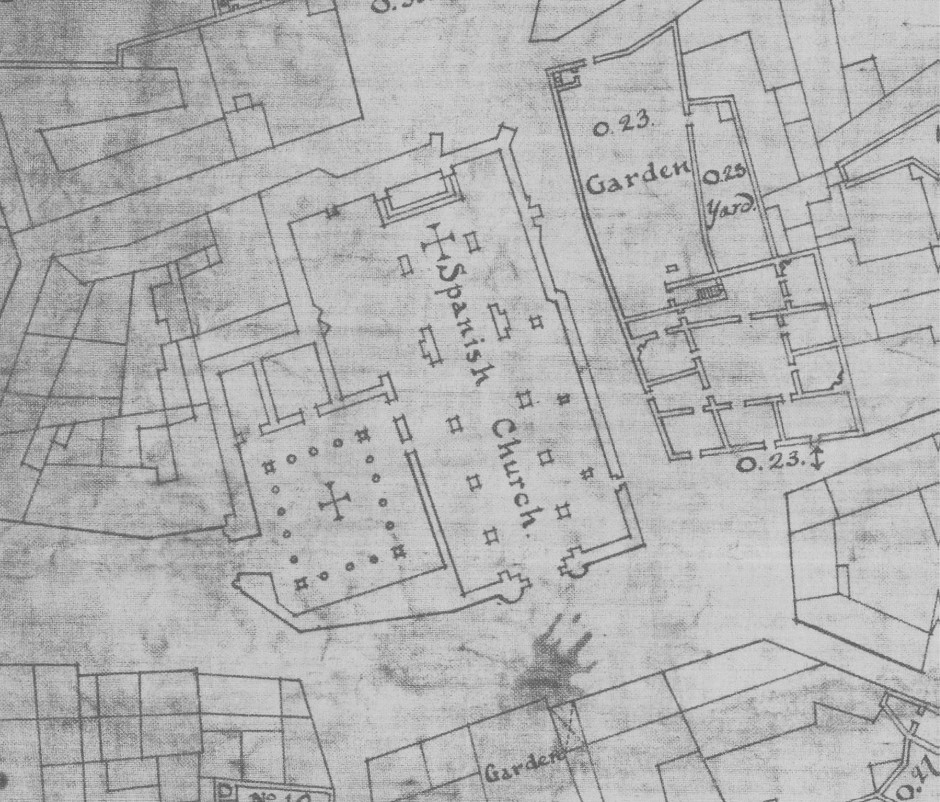
Historical Plan of Cathedral Pre-reconstruction
© 2021 HM Government of Gibraltar
3. Cathedral of St. Mary the Crowned
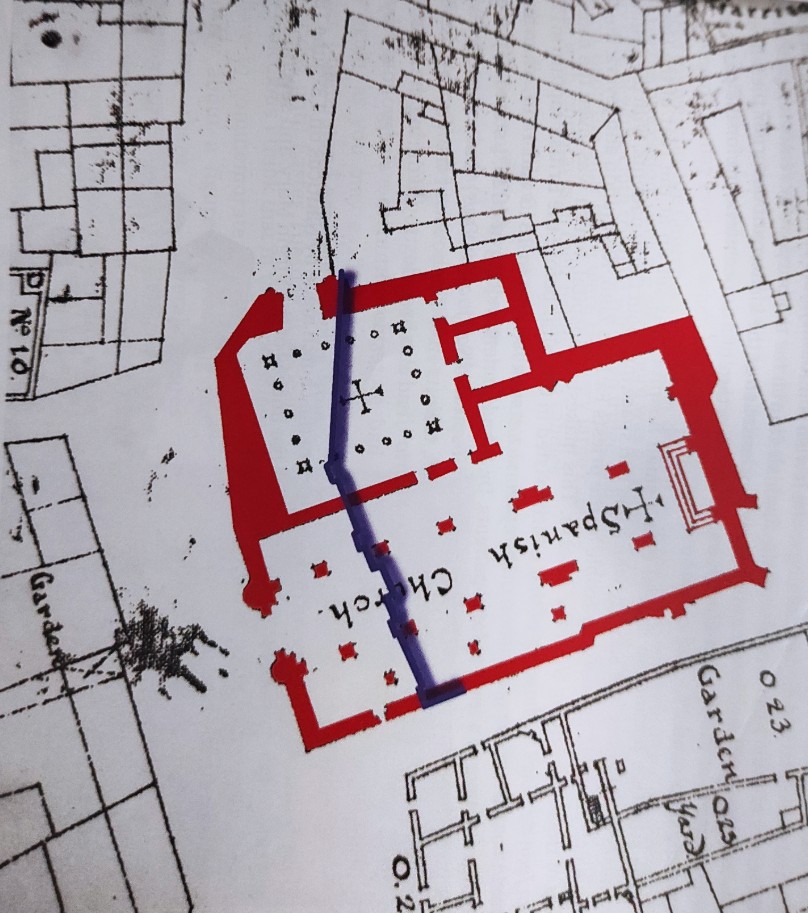
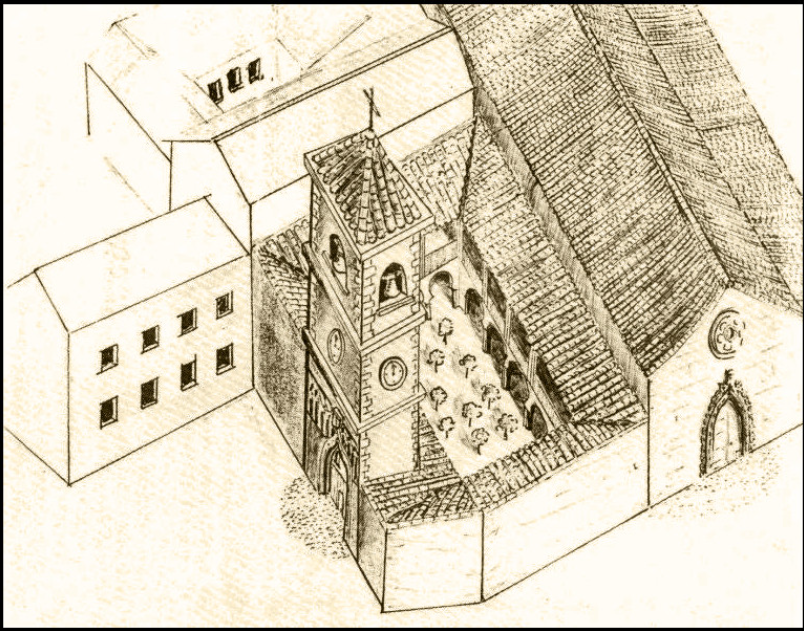
The Cathedral of Saint Mary the Crown was first built as a Marinid mosque between 1342-1350, however during the Conquista Castellano (Spanish Conquest) of 1462 it was decreed that to be stripped of its Islamic past and the only remnants that remain is the churches small courtyard. Under Catholic rule, the new building was erected in a Gothic style with their coat of arms which can still be seen today. During the Great Siege of 1799-1783 the building was severely damaged and was remodelled to allow for a straight pavement and a wider street (see image) by Sir Robert Boyd. This was completed in 1810 and 10 years later a clocktower was added in from of the Patio de los Naranjos which remained to pay homage to its Islamic roots.
4. The Convent (Governor’s Residence)
Originally established as a Franciscan friars convent in 1531 during the reign of Charles I of Spain. The friary's entrance was originally around the back of the current building and extended all the way to the area of John Mackintosh Hall. After the capture of Gibraltar, the friars remained in the convent until 1728 where it was re-established as the residence of the British governor. Elements of Georgian and Victorian influence during renovations can be seen on both building's interior and exterior; through the use of symmetry, multi panelled windows, classical inspirations and textural contrasts. A local ghost story follows that of the 'Lady in Grey' who roams the outside corridors of the guest bedrooms. There are multiple versions of the story, but the one I was told as a child was that the 'Grey Lady' belonged to an affluent Spanish family who was sent to the Convent of Santa Clara (situated in Main Street) after her father discovered she had married against his will. Her lover then joined the Franciscan's and settled into the Convent in order to be near his love and create a plan for escape. On the night of their planned escape, they slipped down to the harbour where a boat awaited them. But the alarm was raised, and during the frantic pursuit the lover fell into the water and drowned. The bride was captured for forsaking her vows, and as punishment she was entombed alive within one of the convent’s rooms.
5. Moorish Castle
As one of the most enduring symbols of the territory's medieval past, the Moorish Castle dates back to the early 8th century and was established during the Moorish conquest of the Iberian Peninsula. The castle standing today owes much of its structure to the Berber Marinid dynasty after they recaptured Gibraltar from the Kingdom of Castile. Aside from its function as a fortification and defensive stronghold, it served as a seat of governance for various Muslim rulers who valued Gib as a key military and trading hub. The Tower of Homage still bears visible scars from cannon fire dating back hundreds of years as it has always remained a crucial military asset on the Rock. This makes it one of the few surviving medieval fortifications in Europe where battle damaged from multiple colonial eras can still be seen on its exterior.
6. Upper Rock Nature Reserve Entry (via Castle Steps)
Enter into the historic fortification zone of the Upper Rock.
7. World War II Tunnels
During WWII, Gibraltar because one of the most heavily fortified strongholds in Europe, and its network of tunnels expanded dramatically to support the Allies forced. From 1939 onwards, military engineers and specialised tunnel units excavated over 30 miles of tunnels using pneumatic drills and explosives. These tunnels contaned everything required to sustained a garrison under siege with: barracks, hospitals, power stations, ammunition stores, communication centres and even an underground bakery. The underground system was so extensive that it had its own internal roadways which were large enough for trucks to drive through. One of the most confidential areas that was only re-discovered in 2008 was a stay behind chamber. Operation Tracer, a concealed chamber designed to hold a six-man team who would remain sealed inside for over a year if Gibraltar fell, was designed to transmit intelligence to the Allies from deep within the Rock.
8. Great Siege Tunnels
These tunnels are one of the most notable engineering achievements of the 18th Century. They were carved out of solid limestone using only hand tools, black powder and extraordinary determination; the soldiers took mere months to excavate the first tunnel. Over the following decades, the networks expanded vastly and played key roles in subsequent conflicts including WWII, when additional chambers were added for communicative, protective and auxiliary purposes. When the Spanish and French force attacked the British territory, the Brits needed a new defensive strategy. Sgt Henry Ince proposed an audacious idea: instead of building gun emplacements on the sheer cliff face, they would tunnel into the Rock and fire from openings carved into the outer wall. His legacy is honoured in many ways, one including Inces Hall, which is one of Gibraltar's main hubs for culture and the performing arts. During the original excavation, the engineers did not initially plan to create the famous windows that overlook the isthmus. The first opening was made accidentally to vent smoke from blasting powder, but the view proved so strategically perfect that they turned it into a firing position. That “mistake” became one of Gibraltar’s greatest defensive innovations.
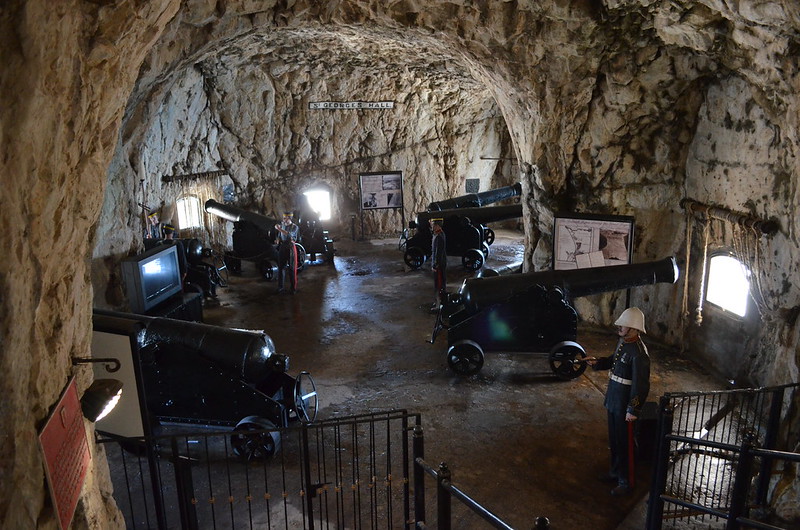
Cannons inside the Great Siege Tunnels © VisitGibraltar.gi
