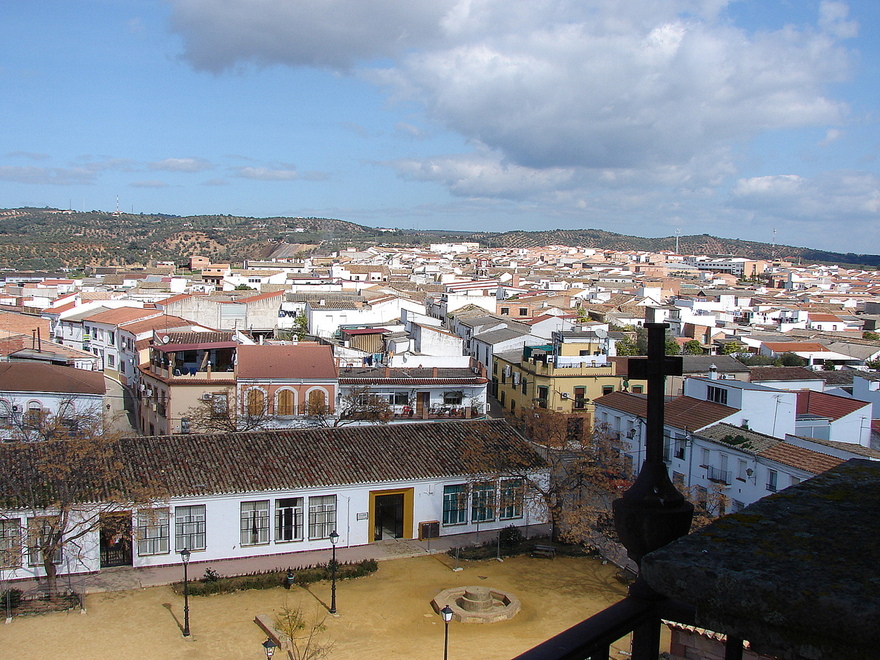
 Adamuz by Rafael Jiménez - Flickr, CC BY-SA 2.0 https://commons.wikimedia.org/w/index.php?curid=97254970
ADAMUZ
by Saskia Mier
Adamuz village is located at the foot of Sierra Morena, next to the Camino de la Plata. The town has about 4,200 inhabitants.
The first signs of human settlement in the Adamuz area were found in caves containing archaeological remains, including human bones and pottery dating back to the end of the fifth millennium BC, in the Cueva del Cañaveralejo. During the Roman period, Adamuz belonged to the Sacilis Marcillus area, which is now known as Alcurrucén and Pedro Abad, as evidenced by Roman inscriptions found there.
The name Adamuz or Alamuz was given to the settlement during the Arab dominion, which would have consisted of an inn for travellers to rest,on the road from Córdoba to Toledo, called Camino Real de la Plata.
From 1260 onwards, Adamuz belonged to the jurisdiction of Córdoba, whose council appointed mayors and officers. Some noblemen and wealthy Castilian residents intended to seize control of Adamuz, as evidenced by the commission granted in 1469 by King Enrique IV of Castile to the Master of Santiago and the Bishop of Sigüenza. The purpose of this commission was to ensure that the Count of Cabra, Martín Alonso de Sotomayor, and Fernán Pérez, as well as the city of Córdoba, reached an agreement to return several forts, including Adamuz.
Ninety-seven years later, in 1566, King Philip II sold Adamuz to Luis Méndez de Haro y Sotomayor, the Mayor of Alcañiz, and it has belonged to the Marqueses of El Carpio ever since. The history of Adamuz would be incomplete without mention of the Convent of San Francisco del Monte, which was founded by Don Martín Fernández de Andújar and confirmed by Clement VII in Avignon, France, on 6 May 1394, at the request of King Enrique and Queen Catalina. Reformations were carried out in the fifteenth and sixteenth centuries by Don Luis Méndez de Sotomayor.
THINGS TO SEE
Casa Señorial de los Lara-Ayllon (Pósito Municipal)
The mansion was built in the mid-seventeenth century, during the most important period in Adamuz's history as a compulsory stop on the Camino Real de la Plata between Córdoba and Toledo. In the mid-eighteenth century, Don Marcos de Lara Ayllón became mayor of Córdoba. While he was staying in Adamuz, Felipe IV spent the night in this mansion. Over the years, the building has undergone several transformations and was used as a hospice during the twentieth century. It is currently home to the Interpretation Centre, the Tourist Office and the Municipal Library. It is located on Calle Constitución.
Torre Reloj
The tower clock was built in 1566 by Don Luis Méndez de Haro, the Marquis of Carpio. The first stone base of the tower features a Latin inscription explaining who ordered the clock to be built and on what date. The tower that can be seen today is not the original, as the original tower was almost entirely destroyed in the Civil War. The current tower is a restoration by the architect Sánchez Puch. It is located in Plaza de la Constitución.
Iglesia de San Andrés Apostol
Similar to the Córdoba churches of the Reconquest, the thirteenth-century church was built in 1260. The current remains date from the late fourteenth century, although various reforms were carried out throughout the sixteenth and seventeenth centuries by Hernán Ruiz. It is located on Calle San Andrés.
Pozo de Santiago
This public well dates from the eighteenth century and was once part of the monumental Ermita de la Soledad, which has since disappeared. It was an obligatory resting stop for travellers along the Camino Real de la Plata. Since its construction, it has provided a rest stop for walkers and a water source for the local community. It is located on Calle de la Soledad.
Ermita de San Pío V
The chapel was once part of the town's only surviving great manor house, popularly known as the Casa de los Riberas. While some parts of the house remain well preserved, others have been modified. It is located on Calle Mesones.
THINGS TO SEE OUTSIDE THE VILLAGE
Pilar del Mesón del Obispo
The former medieval trough belonging to the now-disappeared Mesón del Obispo, was constructed in 1575, according to documents which demonstrate that its existence goes back to the Medieval or Roman era. Located on the Camino Real de la Plata.
Abrevadero Medieval
The medieval trough is a structure that was used for water supply, both for human and for animal use. Although it is not known with certainty when it was built, it has been constructed on an existing infrastructure of Roman origin. This civil work, although it is still being studied and identified, can be dated to around the Middle Ages. Located on the Camino de la Dehesa Vieja.
Fuente Cabrera
The building that we see todaywas built in 1864 under the auspices of the Mayor's Office of Don Juan Rodríguez Tovar.It preserves two differentiated structures, a stone building that houses the water tank and a pillar. Located east of Adamuz, in the vicinity of Arrollo del Caño.
Ermita de Nuestra Señora del Sol o del Cerro
The date of construction of the chapel is unknown; however, the Brotherhood was confirmed in 1630, by Bishop Cristobal de Lobera y Porres. It suffered damage during the Civil War, and in 1951it was completely rebuilt by Regiones Devastadas. Located about eight kilometres from Adamuz.
Tragic train accident near Adamuz, Cordoba in Andalucia.
High-speed train services between Madrid and Andalucia (Córdoba, Seville, Málaga, Antequera and Granada) were suspended following a serious accident at 7.45pm on Sunday, 18 January 2026. The last three carriages of a distinctive red, four-year-old high-speed train operated by Iryo, carrying around 300 .... More >
COUNTRYSIDE WALKS
The Sierra Morena is an idyllic location for walkers, with routes to explore the Ruta del Agua and, of course, the Camino de la Plata. This road runs historically as a backbone to all of Andalucía, and is a strategic point at the Andalucian level as an area of passage between Castile and the Guadalquivir Valley. The route was established from Toledo to Córdoba and Seville, and was originally used as a commercial trade route for tin and later gold, exploited by the Romans.
Hotels in nearby Villafranca de Corodoba
Book Hotels in Villafranca
NATURAL AREAS
San Francisco del Monte
The ruins of the Monastery of San Francisco del Monte are located about 15 kilometreswest of Adamuz. The Monastery was founded in 1385 by, Don Matías Fernández de Andújar, close to the site of the old Mozarabic Monastery of San Zoilo Armilatense, whose remains were used in the construction of the Convent of San Francisco del Monte. It is a place of great scenic beauty and ideal for meditation.
Monte de la Sierrezuela
The Monte de la Sierrezuela consists of 584 hectares owned by the Junta de Andalucía and the Department of the Environment. The area is extremely rich in flora and fauna.
Peñón del Jituero (Peñón del Águila)
The Rock of Jituero is a unique place to explore with convenient access, parking for vehicles and a camping area. It is very much a favoured place among climbers for its perfect visual identification, south-west orientation (which allows climbing in the best conditions even during the most adverse months), the existence of 24 tracks professionally equipped with different levels of difficulty and two fixed points for rappel. Located at Km. 7.1 on the CO-412.
GASTRONOMY
When visiting Adamuz, give some of their local favoured dishes a try such as coña (a name given to the cold tomato and garlic soup, salmorejo cordobés, served with cod and chips), migas (fried bread usually served with pork and eaten with sliced oranges or chocolate) and lechón frito (fried pork accompanied by white wine). Sweet treats include pestiños and perigallos (pastries).
FESTIVALS
Cabalgata Reyes Magos
Three Kings procession celebrated on the evening of 5 January.
La Candelaria
Celebrated 1 and 2 February.
Carnaval
Celebrated in February.
La Botijuela
Oil festival celebrated on 27 February.
Semana Santa
Holy Week.
Judas
Celebrated on Easter Saturday.
Fiestas de la Virgen del Sol o Feria de Abril
Celebrated the third Sunday of April.
Verbena del Carmen
Celebrated the weekend nearest to the 17 July.
Verbena de Santiago
Celebrated the weekend nearest to the 25 July.
Virgen de Agosto
Celebrated on 15 August.
Romería del Cerro
Celebrated the Sunday nearest to the 8 September.
Fiesta de San Andrés (Patrón de Adamuz)
Celebrated on 13 November.
NEARBY PLACES
The neighbouring villages to Adamuzare Montoro, Villafranca de Córdoba and Villanueva de Córdoba.