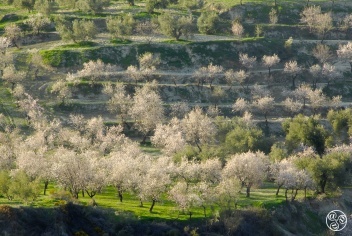
Lora de Estepa
Estepa is said to produce the best extra virgin olive oil in the whole of Seville province and has received various prizes confirming this. It has about 850 inhabitants.
La Roda de Andalucía is well known by travellers because of the N-334 route and the rail line that cross the whole region. It has about 4,200 inhabitants.
The village of Niebla is located roughly 30km to the southeast of Huelva city and 60km from Seville on the shores of the río Tinto. It is located on plain land. With a population of roughly 4000 inhabitants, its relatively small number of inhabitants does not reflect the amount of beauty and archaeological heritage.
This is a strange outpost of the Wild West, with wide, sandy streets lined with houses complete with broad verandas and wooden rails for tying up horses. It is famous for its annual Romería, the Rocío Pilgrimage at Pentecost when it is overflowing with a seething mass of a million pilgrims, either on foot or with horses and decorated carts.
Arising out of the midst of the surrounding greenery, the giant opencast mines of Rio Tinto create a surreal, almost lunar landscape. The removal of layer upon layer of soil and rock, in the search for iron ore, copper, silver and a host of other mineral ores, has tinted this part of the world in hues of dusty pink, brown, yellow, red and grey.
El Saucejo, originally known as La Puebla del Saucejo, is built above the villages of La Mezquitilla and Navarredonda. It has about 4,300 inhabitants.
Many important historical events have occurred in Casariche. There was, for example, a civil war between the citizens of Pompey and Cesar. And numerous archaeological remains have been found in the town, linking its origins back to Celtic times. It has about 5,500 inhabitants.
Algámitas is home to the large rock known as, El Peñón, which sits opposite to the highest point of Seville, Pico del Terril, and Sierra de Tablone. It has about 1, 200 inhabitants.
Aguadulce is home to some of the best quality Spanish purebred horses, raised in the "Hermanos Maldonado" Stud. They have won various prizes from institutions, like SICAB, that recognise their prestige. It has about 2000 inhabitants.
Baños de la Encina offers visitors interesting historical and artistic heritage as well as attractions for lovers of nature. Once called simply Baños, the village adopted ‘de la Encina’ (‘of the holm oaks’) in the thirteenth century, after a reported apparition of the Virgin Mary amongst the oak trees.
Although of significance to both the Iberian and Roman civilisations, it was the Moors who brought splendour to Iznatoraf. During this period, and later under Christian rule, strong links were forged with Granada and Córdoba, and the village prospered.
South of Cordoba, the N331 threads its way through the undulating fields known as La Campiña, dominated by vineyards and vast olive groves. Surrounded by vineyards, Montilla is famous for its excellent wine of the same name; visit one of its bodegas to try it for yourself. Ten kilometres south of Montilla is Aguilar de la Frontera, worth a stop to see its unusual octagonal square.
The Río Guadalquivir flows slowly westwards towards Seville through the fertile heart of Cordoba province, with some interesting towns situated on the river plain.
The Sierra Morena is an area of sparsely populated rolling hills that run across northern Andalucia, creating a natural barrier between Extremadura to the north and Andalucia. Few tourists venture into these wild and remote pine- and oak-clad hills, with its landscape, atmosphere and village architecture more typical of adjacent Extremadura or Castilla La Mancha than the rest of Andalucia, to which it belongs.
Opposite the village is a small island, also called Sancti Petri, with a ruined 17th-century castle, whose tower has been rebuilt and is now used as a lighthouse.
Roquetas de Mar is a fishing town just 15 minutes by car from the provincial capital, Almería. It is famed not only for its fishing traditions, which are preserved today through gastronomy and annual festivals, but also as a coastal resort town. It has around 94,900 inhabitants.
La Campiña is the name of a 'comarca' (region or area) in the centre of the province of Seville. It is made up from 23 municipal districts and other small villages.
Estepa is famous for two very different reasons. Chiefly it is renowned for the biscuits known as polvorones and mantecados which bakers make each Christmas and are traditionally eaten across this region of Andalucía. Its other claim to fame is a grisly mass suicide 2,200 years ago.
Umbrete is not only known for its production of excellent and highly rated mosto (grape juice), but also for its historic and artistic wealth. It has about 8,600 inhabitants.
Sierra Norte is the name of a 'comarca' (region or area) in the north of the province of Seville. It is made up from 18 municipal districts and even more small villages.