Tourist Office in Suflí
The Tourist Office is located in the Town Hall of Suflí, opening from Monday to Friday.
The Tourist Office is located in the Town Hall of Suflí, opening from Monday to Friday.
Festivals in Suflí: Cabalgata de Reyes Magos, Día de la Candelaria, Día de Andalucia, Semana Santa, San Marcos, Cruces de Mayo, San Luis Gonzaga and San Roque.
The Tourist Office is located in the Town Hall of Somontín, opening from Monday to Friday.
Festivals in Somontín: Cabalgata de Reyes Magos, Fiestas de San Sebastián, Día de Andalucía, El Judas, Semana Santa, San Marcos, San Juan, La Ascención, Virgen del Rosario, Virgen del Pilar and Santa Lucía.
The origin of Somontín dates back to the Roman era (second century AD), although evidence suggests that the original nucleus of the village was situated south of the current enclave. The village is likely to have been a place of importance since Emperor Marco Aurelio gave it authorization to coin money.
The Tourist Office is located in the Town Hall of Sierro, opening from Monday to Friday.
In Sierro there are many festivals: Cabalgata de Reyes Magos, Fiestas de San Sebastián, Día de San Blas, Día de Andalucía, Semana Santa and Fiestas Patronales.
The Tourist Office of Serón is located in the Centro de Interpretación Valle de Almanzora Aire.
There are many festivals in Serón, such as Cabalgata de Reyes Magos, La Candelaria, Día de Andalucía, Semana Santa, Entierro de la Sardina, Romería de la Virgen de la Cabeza, San Juan, Fiestas Patronales en Honor a la Virgen de los Remedios, San Miguel and Santa Lucía.
Since prehistory, Serón has been settled by numerous cultures. Among the most interesting local archaeological findings is the presence of the wine glass formation, which occurs along the Almanzora River and spreads throughout Europe.
Note: Due to the construction of the High Speed Train line from Murcia into Almeria the Estación Intermodal station was closed on the 5th March 2024 and trains will stop at Huercal-Viator station and a bus service will be provided to complete the journey. The works are expected to be completed in 2026.
This Almeria part of the Alpujarras is less well known than the Granada Alpujarras to the west. Both parts share the same characteristics and historical origins. They are the sheltered southern facing slopes of the Sierra Nevada mountain range.
There are five municipal districts in the Rio Nacimiento Valley and one has the same name as the river. The highway form Almeria to Guadix climbs this valley. One municipality is unusual in that it is not the name of a village. This is called Las tres Villas (three villages) and was created in 1976 combining the hamlets of Ocaña, Doña María and Escúllar.
Tucked away in the little-visited northern corner of the province is the Sierra María-Los Vélez Natural Park, a surprisingly extensive wooded area, given the otherwise arid aspect of Almeria´s territory, where there are some superb walks. The two main towns in the park - Vélez Rubio and Vélez Blanco - are well worth a visit, particularly the latter for its original castle and Cueva de los Letreros with prehistoric rock paintings.
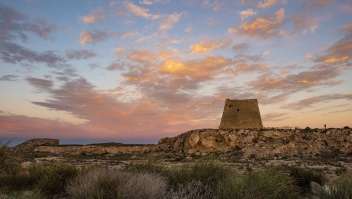
Mesa Roldan is a flat-topped extinct volcano, part of a massive rocky headland topped with a lighthouse and tower, between Agua Amarga village and Playa de los Muertos. It is actually in the municipal district of Carboneras town to the north Mesa Roldan was also featured in the hit series "Game of Thrones," where its dramatic landscape played the role of Meereen.
The River Andarax flows into the Mediterranean sea at the city of Almeria. Inland from Almeria city there are a number of villages that occupy land on the flatter and fertile soil that is not found in the surrounding mountains. Most of the village which are grouped within the Comarca of Cabo de Gata are of little interest to tourists, however Los Millares is Europe´s largest Bronze Age settlement.
Near Chirivel in the Sierra María-Los Vélez Natural Park is an example of a species of juniper, juniper thunifera, or sabina albar in Spanish. It has an impressive age, estimated to be between 600 and 1,000 years old. It is the oldest and largest one of its kind in Almeria province.
A limestone escarpment rising to 1,722m at its highest point of the Lúcar peak, the Piedra Lobera is exceptional for its unique microclimate that has ensured the survival of several rare plant species and others that are unique in Almeria. Its name, the Wolf Rock, refers to the fact that this was the last habitat of the wolf in Almeria province.
Declared a natural monument in 2003, the San Andrés island is 70,307m² and is made of volcanic rock. It is home to many seabirds and has a rich marine life around its shores. The island also has remains of a Moorish necropolis.
Named after a barrier reef (arrecife barrera) of coral because of a similar appearance, this site is colonised by the phanerogam posidonia oceanica, a marine plant endemic in the Mediterranean. The meadow of posidonia oceanica provides a habitat for more than 800 animal and plant species, as well as being a breeding ground for many different types of fish.