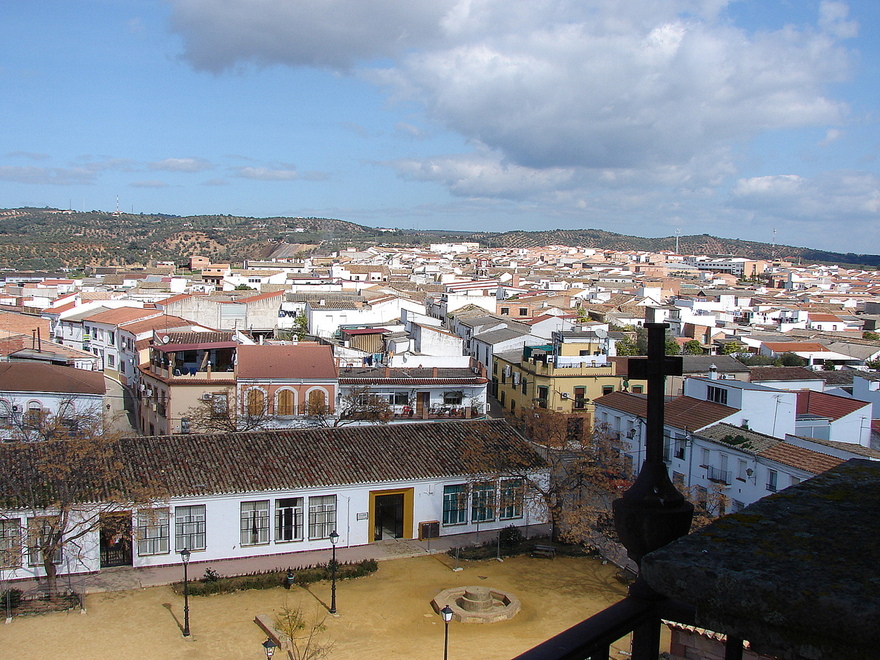
 Adamuz by Rafael Jiménez - Flickr, CC BY-SA 2.0 https://commons.wikimedia.org/w/index.php?curid=97254970
ADAMUZ
by Saskia Mier
Tragic train accident near Adamuz, Cordoba in Andalucia.
High-speed train services between Madrid and Andalucia (Córdoba, Seville, Málaga, Antequera and Granada) were suspended following a serious accident at 7.45pm on Sunday, 18 January 2026.
High-speed train services reopened on the 17th February 2026. However trains between Malaga and Antequera were further disrupted due to a land-slip at Alora on 5th February 2026 caused by weeks of heavy rainstorms. A special bus service took passengers between Malaga Maria Zambrano station and Antequera Santa Ana station.
The accident at Adamuz was the worst peacetime train accident in Andalucian railway history and the worst high-speed train accident since the Spanish network was inaugurated in 1992. The accident, which involved two trains, took place north of Córdoba at 19:45 on Sunday 18 January 2026.
What happened
The last three carriages of a distinctive eight-carriage red, four-year-old Frecciarossa 1000 high-speed train operated by Iryo, carrying around 300 passengers travelling north at 110 km/hr from Málaga to Madrid, was derailed 10 minutes north of Córdoba, near the village of Adamuz. Tragically, one of these coaches then fouled the south-bound track and was hit 9 seconds later by an Alvia RENFE four-carriage train travelling at 205 km/hr carrying 187 passengers from Madrid to Huelva. The braking distance of Alvia units at 200 km/hr brakes is 1,406 meters. (Source). The southbound train derailed and traveled 500 metres before the first two carriages fell off the track bed, descending two metres and coming to a stop against the side of a cutting. Only the two rear carriages remained intact. In total 46 travellers were killed, mostly from the first two carriages of the Alvia. The 27-year-old Alvia driver also died.
The line is described on the this page. The maximum speed on this section of the line is 215 km/h, dropping to 200 km/h in the nearby tunnels and around the tight curves. The tightest of these is the 2,300-metre-radius Adamuz–Villanueva curve. The accident itself occurred on a straight section of double track on an embankment, just north of the Adamuz tunnel and next to the Adamuz halt. This is not a station, but rather a platform used by maintenance crews or for planned train evacuations.
This location provided convenient access for emergency service vehicles to the Iryo train, enabling them to evacuate it in two hours. In contrast, evacuating the seriously injured on the Alvia train, which was located 600 metres south with no vehicle access, took all night. Adif and the emergency services did not initially realise that the second train had also been affected until a passenger walked along the track in the dark to find out why no help had arrived. Guardia Civil officers reached the Alvia train and called for additional support. A team of firefighters from Córdoba then carried the injured along the tracks to the medical emergency services established at the Iryo train.
The Spanish government immediately convened a Comisión de Investigación de Accidentes Ferroviarios (The Commission for the Investigation of Railway Accidents) published a preliminary report five days after the accident, attributing the most likely cause to a metal fracture in the track. The leading wheels of the Iryo train bogies had a notch measuring 1 mm in depth and several centimetres in width. Similar notches had been found on two or three trains that had passed through the area prior to the accident, but none had been found on trains passing through more than an hour earlier. This section of track had been replaced eight months previously.
The the driver of the Iryo train called the Adif Control Centre (Black box transcript published by El Dario) to report “un enganchón a la altura de Adamuz”. The control room instructed the driver to lower the pantograph, which he confirmed he had done. In a second call, the driver reported that his train was fouling the southbound line and requested that all trains on the line be stopped urgently. The Control Centre replied that 'there was no train approaching'. The driver also requested emergency services for injured passengers and reported that a carriage was on fire. The Alvia had already passed the and collided with the rear part of the Iryo train but the driver did not realise this. suggesting that only nine seconds had elapsed. The legacy LBZ signalling system used on this 1992 route does not allow enough time for the brakes to be applied automatically to the southbound train within 9 seconds. The Madrid–Seville line is in the process of migrating to ERTMS Level 2, the current EU interoperable standard, but this is also unlikely to have averted the collision.
We extend our deepest condolences to the families and friends affected by the tragic train accident in Andalucia.
Alternative transport plan
Renfe had put in place an 'alternative transport plan', with trains leaving Madrid every two hours between 07:00 and 19:00, heading alternately for Seville and Málaga. The section between Villanueva de Cordoba - Los Pedroches and Córdoba was completed by a special coach service. All seats were sold at a fixed price of €40 each way. Passengers can request a refund for their original ticket and purchase a new one for this service, or exchange their ticket and receive a refund for the difference in price. Additional trains were also available from Madrid Chamartín station to Andalucia (Seville Santa Justa, Cádiz, Granada and Almería Huercal) on the non-high-speed network. Flights between Seville, Malaga and Madrid airport had been increased as had bus services. The tracks were being repaired, ADIF had hoped to reopen the line on the 2nd February 2026 and then the 7th February 2026 and then 12th February 2026 but was finally reopened on the 17th February 2026 albiet with a 70km/hr restriction.
NEARBY PLACES
The neighbouring villages to Adamuz are Montoro, Villafranca de Córdoba and Villanueva de Córdoba.