
Alhama de Granada
Alhama de Granada is a pretty, ancient spa town located approximately 53 kilometres from Granada. It is perched precariously at the top of a ravine from where the Rio Alham carves through otherwise rolling countryside. There are 6000 inhabitants in the town, and its picturesque location and thermal springs attract many visitors.
History
The area has been inhabited since ancient times, with archaeological remains from the Neolithic period being found in the caves of La Mujer, del Agua, and de los Molinos, in various settlements distributed around the river. The evolution of Alhama began with the Roman settlement, located in the spa area. Some historians believe it may have been the city which Pliny the Elder called Artigi, although this is not certain. The thermal baths, later reused by the Arabs, date from this period; as well as the so-called Roman bridge and a section of an old road. More>
Things to See
Caño Wamba
The fountain is attached to a house, along with the Pilar de la Torre, the Caño de San Diego, and the Pilar de la Carrera, forming part of a single water distribution network that flows from the spring called Nacimiento (in the Játar mountain range). It dates from 1533 and is made of sandstone. On the side walls, you can see remains of the emblems of the Catholic Monarchs, the yoke and arrows, and in the centre, the double-headed eagle, the coat of arms of Carlos V. Located on Caño Wamba.
Pilar de la Carrera
An interesting public fountain in the monumental enclave of Alhama. It is organised around a central, cubic pillar topped with a pinecone-shaped ornament. It is located in front of the Iglesia del Carmen, and opposite the side wall of the old Alcazaba. Located on Carrera Francisco de Toledo.
Antigua Cárcel
The former Alhama Prison is a public building in what is now the Plaza de los Presos (Prisoners’ Square), and houses a punishment cell on the ground floor, as well as a garden area at the rear. On its Mudejar–Renaissance façade, a 1674 inscription recalls that this prison was established during the reign of Carlos II. This building currently houses the CIAG (Centre for the Interpretation, Knowledge, and Dissemination of the History and Culture of Alhama de Granada).
Antiguo Pósito
This simple building stands in the historic centre of the city. It was formerly a synagogue in the thirteenth century and transformed into a granary in the fourteenth century, used as a communal granary for the town. It is now one of the most emblematic buildings in the medieval town, privately owned, and has an interior organized around two large naves separated by a central arcade. The exterior opens onto a simple doorway with a semicircular arch. Located in the Plaza de Los Presos.
Ayuntamiento
The Town Hall is situated on the site of the former Convent of Nuestra Señora del Carmen, which, before becoming the Town Hall, was also the headquarters of the Civil Guard. Its façade overlooks Alhama’s main square and is a two-storey building with wooden ceilings. Inside, it features a courtyard that was once the convent’s cloister, with a double height porticoed on two sides, with semicircular arches, and small heraldic emblems on the central voussoirs. Located on Carrera Francisco de Toledo.
Casa de la Inquisición
An Isabelline, Gothic-style building with Plateresque influences, dating from the sixteenth century. This building housed the Subsidiary Regional Tribunal of the Holy Office of Granada. After many successive renovations, the building became private property. Its façade combines elements of the late Gothic style with Mudejar and Early Renaissance elements, also featuring interesting iconographic references, such as the papal coat of arms and the keys of San Pedro. The house preserves two façades: the main one, with three sections, the lower two carved in stone and topped by a cornice decorated with balls in the style of Juan Guas, while the third remains whitewashed. On this façade, the doorway has a mixed-linear arch, framed by a basket-foot arch, and above it, a mullioned window with a baluster and ogee arches, supported by a double central column with a collar. This building has another rear entrance, leading to a hall with wooden beams and a semicircular arch with brackets at the keystone. Behind it is the courtyard, which has lintelled galleries with stone columns on cubic pedestals and Tuscan capitals, clearly of Mudejar influence. Located on Calle Baja Iglesia.
Hospital de la Reina
A building intended as a hospital; its construction begun in 1485, as the first primary hospital in the Kingdom of Granada, by the Catholic Monarchs. Located in the historic centre of Alhama, it combines elements of Mudejar, Gothic, and Renaissance art. The building is organized around a courtyard, onto which the various rooms open. It is divided into two parts: the main section, which coincides with the section developed around the courtyard, and was built between 1485 and 1510, and a second section, much longer and taller, built in 1540. Located on Calle Hospital.
Puente Romano
This bridge was built during the reign of Octavian Augustus in the first century BC. It is located at the entrance to the town, over the Alhama River, at the Baños Fork. It consists of a single arch and two ascending ramps at either end, forming the roadway. It was the entry point to Alhama and is part of a historic route dating back thousands of years.
Alcazaba
This ancient citadel was built by the Islamic population settled in the region since the arrival of the first Arab invasions. Its conquest by the Catholic Monarchs required a great effort from the Christian troops, and it was soon recovered by the Granada Monarchs. Its definitive reconquest did not occur until February 1482, through the mediation of Rodrigo Ponce de León. The importance of this citadel lies in its history linked to the reconquest of the city of Granada, with its capture being crucial, having surrendered only ten years after the capture of Alhama. The current castle was built on the site of the old citadel, remodelled at the beginning of the twentieth century, and is now privately owned.
Iglesia de Nuestra Señora de las Angustias
This Baroque church is believed to have been completed in the seventeenth century, although some ornamental details appear to be later, such as its chapel, perhaps its most recent part, according to an inscription dating from 1762. The entire church suffered the burning of its altarpieces, images, canvases, and altars during the Spanish Civil War. Only a simple chest of drawers dated 1679, now preserved in the sacristy of the Iglesia de Encarnación and some less valuable canvases were saved. The church was subsequently closed after the war and gradually deteriorated until, in the late 1960s, a heavy snowfall caused the entire roof to collapse. Attached to the church, the Hermandad de la Santa Caridad y el Refugio, linked to it, built a hospital or care centre for abandoned children and the elderly. In the second decade of the twenty-first century, the central nave remains in ruins, and only the transept roof remains. Located on Calle Angustias.
Iglesia de Nuestra Señora de la Encarncación
A church of enormous interest, its powerful rectangular tower, most likely built on the site of the town’s former main mosque, constitutes the visual landmark of Alhama. It was consecrated on April 4, 1482, and is the only purely Gothic parish church built in the Diocese of Granada, as the Mudejar style was used in almost all parish churches. Inside, the Parish and Diocesan Museum was inaugurated in 2001 in the sacristy of this church, where important pieces of goldsmithing and textiles owned by the parish are on display. Located on Calle Alta Iglesia.
Iglesia de Nuestra Señora del Carmen
This remarkable church was built during the Baroque period. It dates from the sixteenth and seventeenth centuries and originally belonged to the former Convento de los Padres Carmelitas Calzados. Its construction began in 1589, and its sanctuary was not completed until the beginning of the seventeenth century, being completed in 1619. During the French invasion, the convent suffered looting of all its assets, and later, with the confiscation of church property by Mendizábal, the religious were expelled, and the cloister, now the Town Hall, became public property. After the earthquake of 1884, the entire complex suffered great damage. Located on Calle Peñas.
Centro de Interpretación
The Alhama de Granada Interpretation Centre (CIAG) is the new centre for the interpretation, knowledge, and dissemination of the history and culture of Alhama. Situated in the former prison, it offers a comprehensive conceptual approach that includes new exhibition techniques such as rear-projected panels, display cases, multimedia and interactive elements, and a 3D projection room. It is organized into six rooms and focuses on the history of the city, including: Visitor Reception Point; Alhama, City of Romances; Water, Source of Health; The Andalusian Earthquake; Alhama, Treasure of Rock and Water; and Carnival. Located in Plaza de los Presos.
Things to see outside the Village
Balneario (Spa) To find the springs, take the turn-off beside the modern bridge over the Rio Alham and follow this for a kilometre or so, through a dramatic gorge. The therapeutic, thermal springs at the Alhama´s Balneario have been channelled into baths since Roman times.
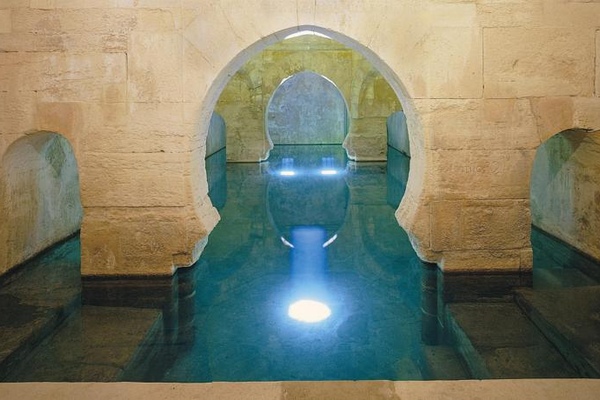
Around 12.30pm daily during the spa's opening season (10 June to 10 October), you can go inside the Hotel Balneario to look at the horseshoe-arched Muslim bath house, which will cost you just a small fee. In front of the park is a small woodland park with a natural hot pool, which is open to the public during the season from 11am to 2pm and 4.30pm to 7.30pm.
Gastronomy
When visiting Alhama de Granada, try local dishes such as olla jameña (chickpea stew), arroz caldoso (rice with meat) and potaje de habichuelas (broad bean stew). Sweet treats include rosco de San Antonio (aniseed doughnuts), pastas de almendra (almond sweets) and tortas rellenas de cabello de ángel (torts filled with candied pumpkin).
FESTIVALS
Popular festivals in Alhama de Granada are La Candelaria, Romería del Vino, Feria de San Juan and Feria de Septiembre.
Music Festival
Alhama Festival de Música
The Alhama Song festival (formerly Alhama Music Festival) celebrated its 60th edition in 2026 by returning to the original song contest format of the early editions. A one day event with ten finalists – solo artists and bands. The 2026 edition also included the show “Tierra” by the Granada-based group “El Hombre Garabato” which was a tribute to the singer-songwriter Carlos Cano. The Cordoba-based band Aslándticos brought the edition to a close.
Founded in 1966 as a local singing competition in Alhama de Granada, it was originally part of the traditional feria, and was called ‘Festival Regional de la Canción de Alhama de Granada'. Over the following years the festival grew in importance and attracted singers from all over Andalucia. In the late 1970s it had a more radical feel, with the campaign for democracy and Andalucia being declared an autonomous community. In the 1980s protest gave way to commercialization, although the festival's title until 2011 was ‘Festival de Musica Joven de Andalucia' (Andalucia Young Music Festival). This was perhaps Andalucia's first contemporary music festival. Renowned national artists headline these days, such as Kiko Veneno. There are two distinct categories: ‘Rock and Pop' and ‘Flamenco Fusion'. The festival is strongly supported by local administration and the competition is still at its heart.
For 2024 the mythical rock band from Granada "La Guardia", formed in the early 80's, led by Manuel España, and considered one of the most important rock bands in Spain, performed on the Friday of the festival. The festival usually takes place on two stages in Patio del Carmen and Paseo del Cisne on the first Friday and Saturday in August. Advanced tickets 10€ (one day) 15€ (two days), from the ticket office on the day 15€ (one day) and 20€ (two days).
In 2021 a winter festival called Salama and took place on 3rd and 4th December in Cintruenigo (Navarra). 2020 was cancelled for Covid. In 2022 the Friday lineup was headlined by Mokinos Escozíos, La Pompa Jonda and DJ Melisa Velasco. Saturday was headlined by Maki y Maria Artes, Alba Lamerced and DJ GesusLpz. In 2017 the first night;competition bands were Derty Dayana, The One and the Other, The Mama Llama, Lucius Blue, Gsus López y Rafa Ortega and on the second night the invitees were Celtas Cortos, Sonido Vegetal, Enseco (winners of 2015), closing with Balkan Fuzion Party: Dj Matt Bombinoff and circus Balkanico.
Previous editions took place on the 1st and 2nd August 2025, 2nd 3rd August 2024, 4th and 5th August 2023, 5th and 6th August 2022 2nd and 3 August 2019.
Nearby places
The neighbouring villages to Alhama de Granada are Santa Cruz del Comercio and Zafarraya.
Bus service
There is a bus service from Alhama de Granada to Granada City, El Almendral and Torre del Mar using the bus company, ALSA. The bus stop is in the centre of the town, on the A-402.
Festivals
Cabalgata Reyes Magos
Three Kings procession celebrated on the evening of 5 January.
La Candelaria;
La Candelaria is celebrated the 2nd February
Día de Andalucía
Andalucia Day is celebrated on the 28th February.
Domingo Piñata
Domingo Piñata is celebrated the Sunday before Ash Wednesday.
Semana Santa
Feria de San Juan Feria de San Juan is celebrated the third week of June.
Romería del Vino
Romería del Vino is celebrated the 15th August.
Halloween and All Saints’ Day
Halloween is widely celebrated in Andalucía today. However, more traditionally on 1 November, the Día de Todos Los Santos is celebrated throughout Andalucía, particularly in the villages located in Cádiz and Málaga.
Book Hotels near the Balneario Alhama de Granada

Tourist Office
Carrera Francisco de Toledo, 10, Alhama de Granada 18120, Granada Monday-Saturday, 10:00-14:00hrs and 16:00-17:30hrs. Sunday, 10:00-14:00hrs. Tel: 958 36 06 86 LOCATION Carrera Francisco de Toledo, 10.