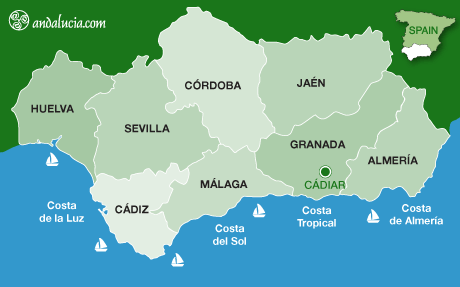
CÁDIAR
Cádiar is a mountainous village that has retained the character and feel of its Morisco past. It comprises three neighbourhoods: Cádiar, Narila and Yátor. It is situated between the Sierra Nevada and the Sierra de la Contraviesa mountain ranges. Some extremely valuable archaeological remains have been found in the village, including medieval ceramics. The village has a population of around 1,600.
HISTORY
The municipality's history is similar to that of other towns in the Alpujarra region. Due to its geographical isolation, the Alpujarra has always developed its own distinct culture, reaching its peak during the Andalusian period when it was an important agricultural centre specialising in silk production. More>
THINGS TO SEE
Posada del Cojo
The Posada or Mesón del Cojo was a popular stopping point for travellers heading to Cádiar, including Aben Jaguar, the uncle of Aben Humeya and self-proclaimed King of Granada, also known as "the Kinglet". More>
Iglesia de Santa Ana
The Church of Santa Ana was built in the second half of the sixteenth century, after the previous church was destroyed during the Revolt of the Alpujarras by the Moorish population. More>
Molino de Enmedio
The Molino de Enmedio is a sixteenth-century mill named after its location between two more modern mills. Built under a three-storey building with a masonry roof, the Molino de Enmedio used a considerable waterfall to obtain the necessary force to rotate the millstone. It is located on Calle Rueda.
Casa de los Chacón (Town Hall)
The house of the Chacón family is a large noble building that, according to tradition, was owned by Aben Jaguar, uncle of Aben Humeya. Later, after several occupations and restorations, in the eighteenth century it was given a Baroque character, suffering great deterioration in the Spanish Civil War. More>
Fuente del Vino
The Fuente del Vino has been designated a Site of Cultural Interest (BIC) by the Junta de Andalucía since 2008. This free wine fountain quenches the thirst of all visitors to the Cádiar fair at the beginning of October. More>
Tinaos de Cádiar
The tinaos are urban structures that perform different functions, among which the most notable are the use as a shelter against inclement weather, connections between streets or for example a meeting place with a socio-communicative purpose. These tinaos date back to before the first half of the twentieth century and above them we can find houses or terraces. Among the tinaos of Cádiar we find those on Calle Real, Calle Cristal, “el Tinao de Juarez Nieto” and the one on Calle Baja
THINGS TO SEE OUTSIDE THE TOWN
Anejo de Narila
There is a road approximately 1 km long between Cádiar and Narila where you can see various places of interest. Notable sites include the impressive Narila reservoir, dating back to the Muslim period, and the renowned 'Olivo del Moro', where Aben Humeya was crowned King of the Alpujarras prior to the rebellion. There is also the well-known estate of Aben Aboo, lieutenant of Aben Humeya, which consists of lands that have not yet been located exactly
Puente del Barranco de Pedro Conde
A Muslim-era bridge located next to the Acequia Real at the height of Narila. It was an aqueduct built to cover the distance between one side and the other of the Barranco de Pedro Conde. According to the information kept in the archives, this bridge was here even before the Christian repopulations after the expulsion of the Moors from the Alpujarra. Due to the lack of information, it is intended to carry out work to study and protect it as part of Cádiar’s heritage
Iglesia de San Esteban (Narila)
The church was built in 1548–1549 by the bricklayer Luis Navarro. In 1555, bricklayer Acacio Hernández and carpenter Bartolomé Vallejo continued the work. The church has a simple nave, with brick and masonry walls. In the 18th century, the main chapel was added, featuring an artistic and interesting Baroque altarpiece. Today, however, both the coffered ceiling and the altarpiece have been lost. The doorway with an undecorated arch is on the left side. The tower, dating from the end of the sixteenth or beginning of the seventeenth century, is made of brick and stands out for its robustness. It consists of a high prismatic body and a bell tower with double recessed openings and moulded eaves. It is located in Plaza San Roque
COUNTRYSIDE WALKS
Visitors will find the area an ideal location for hiking or adventure sports, 4x4 routes and mountain climbing.
- PR-A25: Joins Cádiar and Mecina Bombarón.
- PR-A32: A short route between Cádiar and Barranco Oscuro, in Sierra Contraviesa.
- GR-7: (Satge 4 and 5): A long route between Lobras and Cádiar passing through the Guadalfeo River.
- GR-142: (Stage 5 and 6): A long route between Lobras and Jorairátar, passing through Cádiar.
- SL-A 49: A route from the sea to the sky, climbing up to Mulhacén from Almería (Berja-Trevélez) passing by Cádiar.
GASTRONOMY
The typical dishes of Cádiar are conejo al ajillo (garlic stewed goat), migas de sémola (fried semolina with pork rinds and sausage), gachas de pringue (savoury porridge made with pork), sopa de ajo (garlic soup), potaje de hinojos (fennel stew) and potaje de bacalao (cod stew). Sweet treats include potaje de castañas y anís (chestnuts in aniseed liqueur), roscos de migas (aniseed biscuits) and rosetas de miel (honey pastries).
Hotels in and around Cádiar
Book Hotels in Cádiar
FESTIVALS
Popular festivals in Cádiar are Fiestas de San Blas, San Marcos, Semana Santa, Romería de San Isidro and Fiestas de Octubre. More>
BUS SERVICE
There are bus services from Cádiar to Granada, Berchules, Albondón, Ugíjar and Almeria. More>
WEATHER FORECAST
The weather forecast for the next few days for Cádiar. More>
TOURIST OFFICE
The tourist office of Cádiar is located in the Town Hall. More>
NEARBY PLACES
The neighbouring villages to Cádiar are Lobras, Juviles and Bérchules.