BÉRCHULES
The town of Bérchules is made up of two smaller areas: Bérchules and Alcútar. The village largely consists of working orchards and is served by many different water sources. The sources of the Guadalfeo, Chico and Grande rivers are all located here, making it an ideal location for trout fishing.
The village itself is typically Alpujarreño, and very similar to others in the surrounding area. Its narrow, steep, staggered streets adapt to the terrain, and its traditional whitewashed houses have flat slate roofs. The village has a population of around 810.
HISTORY
The origin of the name Bérchules is believed to be derived from the Arabic 'berchul', meaning 'vergél' (garden), possibly due to the abundance of springs, fertile lands and pleasant temperatures, despite the town being located at an altitude of over 1,300 metres and close to the perpetual snows of the Sierra Nevada. More>
HOTELS IN BÉRCHULES
THINGS TO SEE
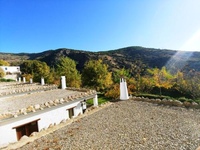
Era García
Eras are threshing floors that were used until recently to separate grain from cereal and dried legume plants. This process is called 'parva'. The oldest threshing floors, and those found next to farmhouses, are circular and paved with boulders... More>
Iglesia de San Juan Bautista
This church, which was built between the sixteenth and seventeenth centuries, stands on the site of an old mosque. It consists of three naves, each of which is separated by four arches. More>
Lavaderos
The municipality has several lavaderos, or washing areas, including the Fuente Grande, Portón, Barrio García, Fuente Grande de Alcútar and Caldedería sites. More>
THINGS TO SEE OUTSIDE THE TOWN
Iglesia Santa María la Mayor de Alcútar
The primitive church from the 17th century was destroyed by the Moors during the Rebellion of Las Alpujarras. During this rebellion, the Moors entered the church during midnight mass on 24 December and killed everyone inside except the sacristan... More>
Ermita de Cortes
This chapel is located in the Sierra de Bérchules, specifically in an area known to the municipality's inhabitants as Cortes or Cortijo del Cura. More>
NATURAL AREAS
Parque Natural de Sierra Nevada
The Sierra Nevada is a dramatic and rugged mountain range, the highest in Europe after the Alps. It is the most significant section of the Cordillera Penibética. The central protected area of the national park encompasses 85,883 hectares of snowy summits, torrential rivers, sheer-sided gorges and stony scree slopes, as well as glacial lakes. An outer protection ring, the Natural Park, covers 86,335 hectares and extends from the National Park to the foothills, including the Alpujarras in the south, where cultivated terraces of almond trees and vegetables can be found. Popular activities in the parks include skiing, hiking, mountain biking and attending summer camps. Visitors can simply travel and discover the area's fauna and flora, visit its lagoons and enjoy the adventure of exploring this vast landscape.
Red Natura 2000
The Natura 2000 network comprises a series of biodiversity conservation areas across Europe. Consisting of Special Areas of Conservation (SACs) established under the Habitats Directive and Special Areas of Conservation for Birds (SACs) designated under the Birds Directive, it plays a key role in the conservation of Europe's natural habitats and wildlife. The network's primary goal is to promote the conservation of biological diversity while considering economic, social, cultural, and regional factors, and to support the broader goal of sustainable development. This is because maintaining this biodiversity may sometimes necessitate the continuation or encouragement of human activities. The network establishes an ecosystem and network management system for protected areas of community interest across Europe. This approach, first introduced in the Birds Directive in 1979, is reiterated in the Habitats Directive and implemented through the creation of Natura 2000. The Habitats Directive requires Member States to promote the overall coherence and proper functioning of the Natura 2000 network by maintaining landscape features that are important for wildlife. Management is carried out in collaboration with local stakeholders. Natura 2000 is not intended as an adornment for natural sites; rather, it participates in, and often promotes, existing traditional human activities alongside the conservation of local natural heritage. The Natura 2000 network therefore plays a crucial role in protecting EU biodiversity from the impact of activities carried out by its citizens. The aim is to conserve wild flora and fauna and their natural habitats in Europe, either by maintaining them or restoring them to favourable conservation status. To this end, a large network of natural sites with specific conservation objectives has been established at a European level.
COUNTRYSIDE WALKS
There are various hiking routes in the area for those keen on hiking, such as the Sendero Sulayr, the Sendero del Mar al Cielo (3rd stage: Jorairatar–Bérchules), the Sendero del Mar al Cielo (4th stage: Bérchules–Trevélez), the Sendero GR7 (Mecina Bombarón–Bérchules–Alcútar–Cádiar), the Sendero del Río Grande, the Sendero de la Vereda de Misa, the Sendero Local (Junta de los Ríos), the Sendero de las Acequias and the Paseo de la Fuente del Agua Agria.
BUS SERVICE
There are bus services from Bérchules to Granada, Almería and Alcútar. More>
GASTRONOMY
The typical dishes of the village are the asadura matancera (stewed liver), sopas de pimentón (pepper soup), gachas de caldo colorao (broth porridge), choto al ajillo (stewed goat), potaje de hinojos (fennel stew) and habichuelas con jamón (broad beans and jamón). Sweet treats include buñuelos (dumplings) and roscos fritos (doughnuts).
FESTIVALS
Popular festivals in Bérchules are Santo Cristo de la Misericordia, San Pantaleón, Fiesta de San Marcos, Semana Santa and Romería de San Isidro. More>
WEATHER FOARECAST
The weather forecast for the next few days for Bérchules. More>
TOURIST OFFICE
The tourist office of Bérchules is located in the Town Hall. More>
NEARBY PLACES
The neighbouring villages to Bérchules are Alpujarra de la Sierra and Cádiar.
DIRECTIONS
Bérchules is 100km from Granada city. From here, take the A-44 (direction Armila-Motril, then leave at exit 164 to join with the A-348. Continue until you pass the Cádiar crossing, to join with the C-332 and then the GR-421.
