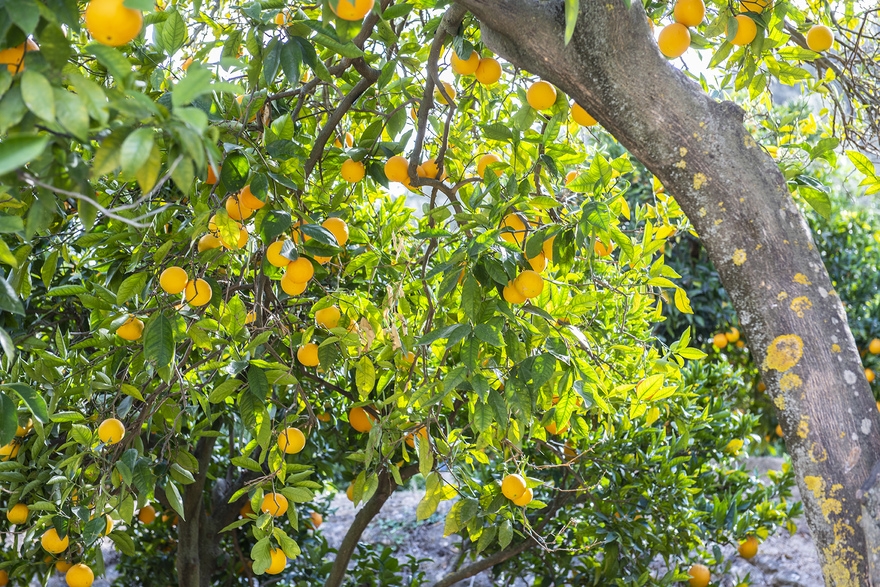
 Oranges grow in abundance in El Valle
History of El Valle
The towns of Restábal, Melegís and Saleres did not come together as El Valle until 10 October 1972, when they were united under the same council, which adopted the name El Valle and established its headquarters in Restábal. However, these three towns have experienced similar historical development over the centuries due to their geographical proximity, as have the other towns in the Lecrín Valley of Granada.
As data on the history of the three population centres is limited in the early stages, we can assume that data supporting a human presence in the Lecrín Valley during these historical periods are applicable to this area. The lower part of the valley is strategically located, leading to settlement by groups due to the presence of aquifers and fertile land, as well as its location on the natural route of communication between coastal and valley regions.
Data on the history of the three population centres is limited in the early stages, so we can assume that data supporting human presence in the Lecrín Valley during these historical periods are applicable to this area. The strategic location of the lower part of the valley led to settlement by groups due to the presence of aquifers and fertile land, as well as its location on the natural route of communication between coastal and valley regions.
Settlements of the Iberians, Phoenicians and Romans also passed through here, as evidenced by the numerous vestiges found, such as the tegulae (tiles) and sigillatas found in Saleres. The Acequia de los Arcos, an aqueduct that brings water from the Grande River in Cónchar to Melegís, dates from the same period. The 800 years of Muslim presence left their mark on the towns, particularly in terms of their agricultural and urban appearance. According to some authors who described the Kingdom of Granada, the centres of the valley were included in the Cora de Elvira, and the first written references date from this period.
During the final years of the Nasrid Kingdom, Melegís briefly became the capital. Evidence of this period includes the Castillo de Restábal, which is located in a strategic position that allowed visual control of the surrounding area, next to the Marchal watchtower in Saleres. In 1489, Zagas's possessions were ceded to the Catholic Monarchs; in 1490, Boabdil recovered the Lecrín Valley's fortresses except for Mondújar; and in 1491, the Christian troops led by the Marquis of Villena recovered them, destroying the Castillo de Restábal and sacking and burning nine towns in the lower valley. This was a prelude to the conquest and annexation of the Kingdom to the Crown of Castile.
In 1501, the Archbishopric of Granada established the parish institution of Santa María in Restábal, one of the three main parishes in the region. It had seven annexes under its authority and employed four beneficiaries and four sacristans. During the Morisco uprising against Felipe II's strict measures (1568), the churches of the three villages were burned down, along with the old Christians entrenched inside them. Following these events, the Christian offensive intensified. In July 1569, the Moriscos took refuge in the Restábal-Saleres mountain range and were discovered by Captain Céspedes, who was killed instantly. His body was buried in the church of Restábal days later. In November 1570, the Moriscos were finally expelled, resulting in a significant decrease in the population of the farmhouses. These were subsequently repopulated by Christians from elsewhere in the peninsula.
At the beginning of the seventeenth century, in 1616, the villages were sacked again, this time by militias from Granada. On their way to the coast, they were warned in Restábal and Béznar to withdraw. The population declined significantly after the epidemics of 1632 and 1649.
In the eighteenth century, the Lecrín Valley was notable for its allegiance to the Bourbon dynasty during the War of the Spanish Succession. Various studies conducted since the end of the previous century have provided data on these towns that coincides with that of Pascual Madoz. In 1851, Restábal and Melegís had a school, a grain store and a fountain to supply the population, as well as a tower and a prison in Restábal. Christmas 1884 was marked by a fierce earthquake in Alhama. Between August and September of the following year, a cholera epidemic caused 31 deaths in the three towns.
Between 1906 and 1910, the road was extended to reach Melegís and Restábal, complete with the Hijones, Melegís River and Restábal bridges, as well as several smaller bridges en route to Pinos del Valle. On 25 April 1908, the San Antonio Power Station was inaugurated on land in Melegís near the Cortijo de Budas. It supplied the towns in the lower valley, including Lecrín and Cónchar. The station was known as the 'Light Factory' and the river that was diverted for its use was called 'The Canal'. All of this hydraulic architecture was submerged under the waters of the Béznar Dam. Two years later, on 10 May, the Granada–Restábal–Pinos del Valle connection began operating by gondola carriage.
The Spanish Civil War (1936–1939) resulted in many casualties and left the municipality under the control of nationalist troops. The mountain range became a border area. Around 1757, telephone connections arrived in the villages of the valley, with a single switchboard in each town. The three villages merged in 1972. Between 1977 and 1985, work was carried out on the Béznar Reservoir, which was built on the lands of Restábal and Melegís and is fed by the rivers of the same name.