Main Sights

Arco del Barbudo

The arch was an integral part of the former Puerta de Baeza and constituted one of the entrances to the walled enclosure. It is named in honour of Martin Yañez de la Barbuda, Master of Alcántara , who in 1394 left through it to fight against the Moors of Granada. In 1447, the Benavides family, including his relative the poet Jorge Manrique, whose daughter was married to a Bevanides, entered the enclosure through this door in order to expel the Carvajales family from the Alcazar./p>

Antiguo Hospital de San Antonio Abad

This building was founded in the early sixteenth century as a hospital. In 1791, by order of Pope Pius VI, the Order of San Antonio disappeared, incorporating its assets in Baeza, including the hospital, into those of La Concepción.

Antigua Universidad e Iglesia de San Juan Evangelista

This piece of civil architecture is a great representative of the city’s mannerism, carried out by order of the Administrator and Priest Pedro Fernandez de Córdoba on the site of the Franciscan Convento de San León , ceded in 1571. The works were completed in 1593, except for the façade and Capilla Mayor , which were completed in the seventeenth century.

Balcón del Concejo Consistoriales Bajas

Construction of the Royal Box was ordered in 1684 by the Corregidor Fernando Ladrón de Guevara, created by Juan Guerrero and Mateo de Molina, due to the importance that the Plaza del Mercado was acquiring as a place of commerce and leisure. The balcony was inaugurated in 1701, on the occasion of the wedding of Felipe V with Maria Gabriela de Saboya.

Arco de Villalar

The arch was erected by the Council of Baeza in 1522 to commemorate the victory of Emperor Charles V’s army over the Comuneros in the Battle of Villalar, which took place in 1521. Although some sectors of the Baeza nobility, led by the Benavides family, took the side of the Emperor’s opponents, their position was justified by their personal confrontations with the Carvajales family, which at that time controlled the Town Hall, than by open opposition to imperial politics.

Palacio de los Salcedo

The palace was built by Juan Rubio de Salcedo at the beginning of the sixteenth century in the Renaissance style with Gothic influences. It has preserved its original typology: the courtyard with galleries on three levels, semicircular arches and a flat upper gallery. Located on Calle San Pablo.

Puerta de Jaén

This gateway is one of the most important and best defended entrances to the medieval walled area. Isabel la Católica ordered its demolition in 1476. It was rebuilt in 1526 by Corregidor Álvaro de Lugo in commemoration of King Charles V of Spain (and from 1519 Holy Roman Emperor) ’s visit to Baeza after his wedding in Seville in 1526 and honeymoon at the Alhambra Palace in Granada.  

Santuario de la Virgen de la Luz, Tarifa

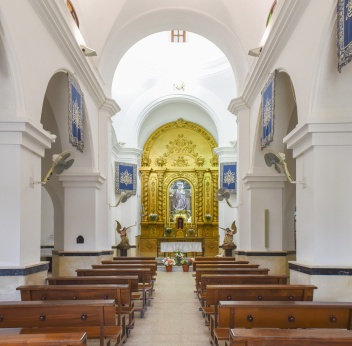
According to legend, the Santuario de la Virgen de la Luz was ordered by Alfonso XI to commemorate the victory in the battle of Salado. The church itself has a has a Latin cross plan made up of three naves and a chancel. An attached courtyard with central fountain was added later with small rooms for the brothers. The church has a glass fronted room behind the altar for the image of the Virgin which was made at the end of the 16th or beginning of the 17th century.

Puerta de Úbeda

Puerto de Ubeda is undoubtedly the best fortified gate of this walled city, it was the one that led to the road to Úbeda. It used have three arches reaching across to the old ‘Albarrana tower’ but today only one arch remains. The the Albarrana tower and the walls were ordered to be destroyed by Queen Isabella in 1476 to end the disputes of the local nobility.

La Alhóndiga

The Alhóndiga was a grain trading exchange house built in 1554 by the Corregidor Don Hernando de Acuña. The building was connected to the granary through a vault. The fact that this building was located in the market square would enhance the commercial, public and civil importance of this square.

El Pósito

The ‘Posito (old granary) building is a was constructed in the sixteenth century as indicated by the date engraved on the facade. It was connected to the  Alhóndiga through a vault being the important store house of the grain.  

Town Hall and old Court House

In 1502 King Charles I was made aware of the need to build a new prison in Baeza due to the poor conditions of the existing one. The building was constructed in 1520 and the Casa de Corregidor was constructed in 1559.

Casa del Pópulo (Antigua Audiencia Civil y Escribanías)

The Casa del Populo was built around 1535 in a Renaissance architectural style in two sections. In the lower section there are six linteled openings, one for each Notary's Office. On the façade between each office there are ornamental columns ‘supporting’ a lateral lintel and above this, keystones decorated with engravings of seven lions. In between on the façade are six shields of the city.

Antiguas Carnicerías

The old butchers building was both a butchers and Municipal slaughterhouse. The original building was built in 1547 during the reign of Charles V and was located outside the city walls. In the 1960s it was rebuilt in the newly reformed Plaza del Pópulo. As the original building was longer than the new Plaza de Pópulo the ends were "folded" back to the sides.  

Santa Catalina Castle, Tarifa

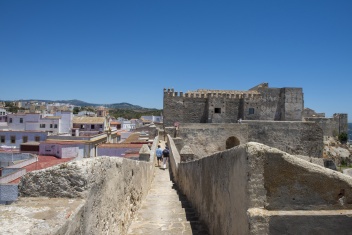
Castillo Santa Catalina is an observation tower which was constructed in 1931 in the style of a 16th-century castle, on a small hill of the same name. The ‘castle’ has a large, strangely out-of-proportion observation tower with mudejar arches and balconies on the corners, and has become a much-loved symbol of Tarifa.

La Alameda, Tarifa

This is a typical Andalucian tree-lined avenue with bars and restaurants, where the old folk sit on wrought-iron benches in the shade of the vast palms. You will find a number of good restaurants with outside terraces along the east side of the square - the restaurants are actually built into the old city wall and, unusually, have entrances on both sides of the wall.

Little Frog Square - Plaza de la Ranita, Tarifa

This central plazain Tarifa town has three names. Officially called Plaza de Santa Maria, after the church on one corner, its older name of Plaza Alfonso XII is still on the wall. However it is known locally as Plaza de la Ranita, or Little Frog Square, thanks to its unusual star-shaped fountain featuring eight ceramic frogs, one on each point, and a very Moroccan shade of turquoise.

Miramar Gardens and Viewpoint, Tarifa

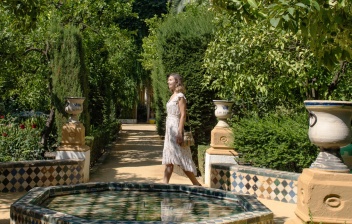
You can get an impressive view over the Straits of Gibraltar to Morocco from the Miramar Gardens on Calle Amargura next to the Town Hall in Plaza de la Ranita. The gardens are located on top of the old city walls, providing an ideal vantage point across the sea to Africa.

Tarifa Municipal Museum

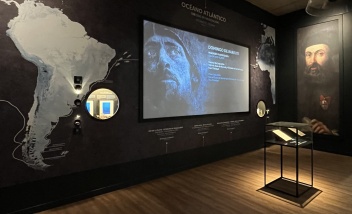
The Municipal Museum in Tarifa is well worth a visit. It is located in the same attractive square as the Town Hall, officially called Plaza de Santa Maria, but known locally as the Square of the Little Frog. Inside you can see artefacts from Neolithic, Roman and Moorish times.

Puerta de Jerez, Tarifa

Jerez Gate is is a medieval gateway flanked by two crenellated towers and the only entrance through the old Moorish city walls that remains today of the four original ones - as the name suggests, this gate gave access to the road northwards to Jerez de la Frontera.