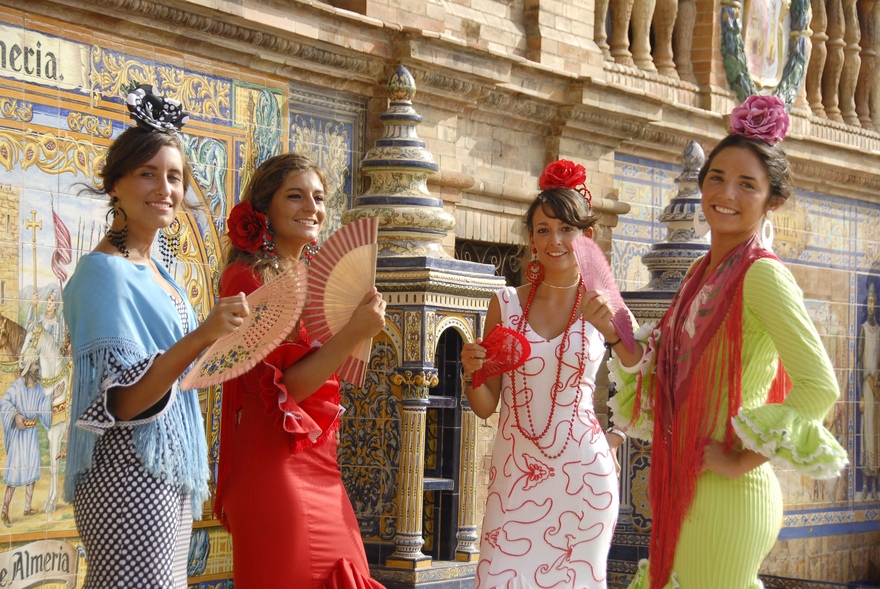
 Golden rules for surviving the Seville Feria — and doing it in style
The Universal Seville Feria Survival Guide
Golden rules for surviving the 2026 Seville Feria — and doing it in style, written by our contributing editor and long-time Seville resident, Fiona Flores Watson.
The Universal Seville Feria Survival Guide
If you’re heading to Seville’s most iconic celebration, consider this your essential insider handbook. The Feria is not just a huge party, or fair, it’s a full-body endurance test. Follow these golden rules to survive - and thrive - in style.
 The andalucia.com Survival Guide complete with checklist, for first-time visitors to the Seville Feria 2026
1. Know About Casetas
Most casetas (small tents) are private, owned by companies, associations, or groups of friends and family. If you’re invited in, you’re being welcomed into a special, private celebration — respect the space, and enjoy the hospitality. If you don’t have your own caseta, there are several public ones, from municipal neighbourhoods to anarchist collectives. More>
2.Dress the part (or respect it)
You don’t have to wear traditional flamenca dress (tight bodice with layered frilly skirt) to the Feria, but if you do, be sure to do so properly with all the accessories – shawl, earrings, flower(s) in hair etc. Many second-hand shops in Seville stock flamenca dresses, and you can find them on Wallapop and Vinted; you can also hire them from places like Ponme Flamenca in Alfalfa and Flamenco y Mas in San Luis. If you’re not going for the flamenca look, aim for smart, summery elegance, such as a stylish dress or tailored trousers with a fancy top — this is not a casual festival if you want to fit in. More>
3.Don’t be a bag lady
It’s not considered cool to take a bag to the Feria, as it spoils the line of the dress, although some ladies have small, pretty pouches on a long shoulder strap to carry essentials (keys, phone, cash, tissues). Most dresses come with zip pockets in the skirt lining: you lift up the outermost frill to access the pocket, which will fit a phone, keys and lipstick.
4.Fans are not optional
An abanico (fan) isn’t just an accessory at the Feria — it’s a piece of survival equipment. Temperatures can be high during the day, especially if the fair pushes into late April/May, and you’ll be on your feet dancing, walking, and socialising. Most casetas have fans, a few have air-con, but it’s likely you will glow during your time at the Feria, and that draft of air on your face will be extremely welcome. Bonus: locals use fans with flair - colour-coordinated with their outfit, obviously - so it doubles as a style statement. See more about the history of abanicos >
5.Footwear will make or break you
This is not the place for brand-new shoes. Whether you’re in traditional dress or not, comfortable, worn-in footwear is essential. The Feria ground is huge and you will walk a lot. Locals usually wear esparto wedges, coordinated with their dress or outfit, which are very reasonably priced. Look in the shoe shops near Salvador church.
6.Book your hotel early — very early
Accommodation fills up months in advance. If you’re planning to attend, book as early as possible or risk paying premium prices, or worse, staying far outside the city.
7.Feria by day vs feria by night
Feria del Día: Bright, vibrant, and family-friendly. Expect horses, carriages and a more traditional atmosphere with lots of children of all ages.
Feria de Noche: The energy shifts — louder, livelier, and more intense. Dancing continues into the early hours, and most people don’t wear flamenca dresses, but smart, even glam, evening wear. Some of the barrio casetas in calle Pascual Martinez, the part further from the portada, can be a little rough in the late hours. To truly experience the Feria, visit both by day and at night.
8.Putting shade on sunglasses
This might surprise visitors, but wearing sunglasses is not seen as cool, which can be tricky in the afternoon when the sun is very bright. The Feria is about connection, eye contact, and presence — so leave the shades off when mingling.
9. The Flower Rule
If you’re wearing a flower, or flowers, in your hair (see 2), placement matters:
- On top of your head, with your hair pulled back into a ponytail or more elaborate hair-do = traditional and stylish. Easy for those with long, straight hair.
- On the side, above your ear = less typical, but more practical for those with short and/or curly hair; curls will hide a top-set flower. Also good for long loose hair styles.
- Either way, ensure it is securely fixed in place with hair grips, and take spares.
10.Master the drink: rebujito is your best friend
The drink of the Feria is rebujito, a refreshing mix of manzanilla sherry and lemon soda. It’s light, easy to drink from the small glasses it’s served in, and dangerously moreish. Pace yourself and drink some water from time to time – you’ll have to buy a bottle. Beer is also a popular drink at the Feria, as throughout Seville.
11.Feria Fare
Each caseta has its own bar: typical dishes include fried fish (especially on Monday night), Iberian ham, prawns, cheese, croquettes, and tortilla. Food is generally good quality, if expensive.
12.Pace yourself — it’s a marathon, not a sprint
The Feria lasts six days (Tuesday to Sunday). Late nights, early starts, dancing, heat, and rebujito add up quickly. Take breaks, eat well, and don’t try to do everything in one day. Sevillanos stay late for nights on end – their stamina is extraordinary.
13.Dance the night away
Sevillanas, the local flamenco-inspired dance, are divided into four sections. The steps are complex, so if you haven’t learned them, try to dance with someone who does know: mirror your partner, turning and swapping places at the right times, keep your arms aloft, and above all, smile and look like you're having fun!
14.The lighting of the arch
The alumbrao (lighting up of the arch, which has 28,000 light bulbs) takes place at midnight on Monday night. This is when the Feria officially starts.
15.The fairground
The recinto is a large area in south-west Seville, with 14 streets named after bullfighters, lined with over 1,000 casetas; there are also two information kiosks and a dress-mending service. Next door is a funfair, Calle del Infierno. Download a map onto your phone, and/or get a paper one from an information kiosk. The index is handy for finding casetas, especially the free-entry (public) ones!
16.Siesta or no?
If your accommodation is close enough to make going back worthwhile, then head home for a siesta after lunch, to sleep or rest, or at least put your feet up, and come back at night showered, recharged, and in a fresh outfit.
17. Good days to go
Tuesday to Thursday are the best days; Wednesday is a holiday in Seville so it’s especially busy. After Thursday, many sevillanos go to the beach and the Feria doesn’t have the same atmosphere.
18.Transport
Many buses lines run to the Feria, and three Metro stations are nearby, with 24-hour services (Blas Infante, Parque de los Principes and Plaza de Cuba). You can also get a taxi, although the queue for licensed Seville taxis at night is extremely long. For more How to get to the Seville Feria.
19.Parking
Charco de la Pava is the nearest car park, with shuttle buses running from next to Blas Infante metro station.For more How to get to the Seville Feria.
20.Charge your phone
Make sure your phone is fully charged, and take a battery pack if in doubt, as you will be using it a lot. You will find photo opportunities galore, plus you might need it to find your friends, if you get lost in the crowd.
21.Take your address
In case you forget the name of your hotel, and its address, make sure you take a card with the information. If you’re staying in a holiday rental apartment, write down the full address (both apartment and street numbers) on a piece of paper safely stored in your bag/pocket. In a new, unfamiliar city, it can be confusing to find where you’re staying. Sometimes it’s easier to show the taxi driver the address than try to explain, especially after an afternoon/evening drinking rebujitos.
22.Horse-drawn carriages
This is the traditional way to arrive at the fair, and also to ride around the recinto looking at the other people, and so that they can also look at you. Bottle of Manzanilla sherry, optional. Attitude, essential. The horses are embellished with colourful accoutrements, and the drivers (in pairs) are always beautifully turned out. As a pedestrian, be careful when crossing roads, which are packed with carriages until 8pm. More >
23.Card sharp
The easiest way to pay is with your phone, but take some cash and a bank card in case your phone dies.
24. Shoe shine
Men usually wear black lace-ups shoes or loafers. Don’t wear sneakers or trainers unless you are seriously working the smart-casual look by pairing them with a suit.
A checklist for visitors to the fair
✅ Phone with external battery and cable
✅ Cash and bank card
✅ Paper map of Feria ground
✅ Sunglasses (even though some say it’s not cool)
✅ Make-up essentials
✅ Tissues (for when the toilet paper runs out)
✅ Your accommodation address
✅ Transport card
Final Word
The Seville Feria is one of Spain’s most unforgettable experiences — equal parts elegance, chaos, and joy. With the right mindset (and the right shoes), you won’t just survive it — you’ll love every second.
This page forms part of the Andalucia.com Spring 2026 Newsletter
Spring 2026 Newsletter - From Dial Up to Digital
Spring 2026 Newsletter - 30 Years of Passion - The Universal Seville Feria Survival Guide
Spring 2026 Newsletter - 30 Years of Icons - The spirit of Andalucia - Festivals
Spring 2026 Newsletter - Contributor Spotlight - 30 Years Behind the Lens
