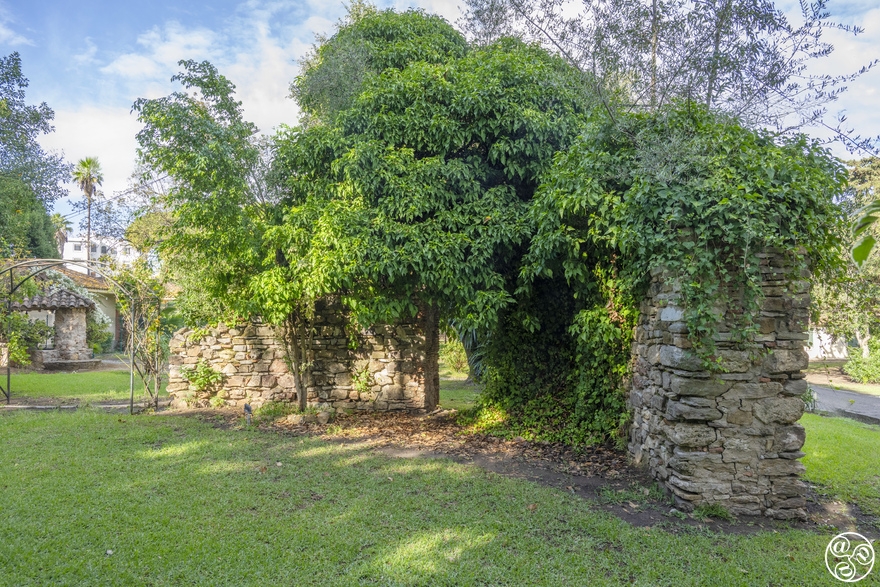
 There are remains of an 8th-Century Mosque and a Moorish well in the grounds of the Hotel Reina Cristina © Michelle Chaplow
Great Mosque of Algeciras
The remains of the the Great Mosque of Algeciras (Mezquita Aljama de Algecira), was constructed in 778 AD. Historians consider these archaeological remains significant, as they are believed to belong to the very first mosque built on European soil.
History
Tariq ibn Ziyad, the Moorish commandant at Tangier invaded Iberia in 711 AD in the name of Musa, the Governor of Ifriqiya (North Africa). Tariq had landed at Gibraltar regrouping and marching on and seizing Algeciras. More>
Within five years all of Iberia, except Galicia and Asturias were in Muslim hands. Musa travelled to Damascus to give his account of the opportune conquest to the Caliph, and laid at his feet an immense booty and thousands of captives. When in 750 the Abbasids overthrew the Umayyads in Damascus Abd-ar-Rahman I travelled to Al-Andalús where he formed a new Umayyad emirate, or state, based in Córdoba. More>
Accounts tell us that the Algeciras mosque was built in 778 AD at a time when Algeciras, which was then known as Al-Jazirah Al-Khadra ("The Green Island"), served as the strategic gateway for the Umayyads. The Great Mosque was constructed as the city's primary religious center, intended to reflect the importance of this first foothold in al-Andalus.
Whilst the mosque was commissioned Abd-ar-Rahnab I (also written as Abderraman I) , it was designed by architect 'Abd-Allah Ben Jalid. This area was heavily fortified and stood on a hilltop. It was constructed over a older place of worship, probably a Byzantine church or a Roman temple serving the Roman city of Iulia Traducta.
According to the Institute of Campo de Gibraltar studies (IECG) the mosque had the classic layout of a place of worship used by Muslims on the Iberian Peninsula since the Emirate period. It was divided into two parts: a covered section, which was the prayer hall or haram, and an open-air section, the sahn or courtyard. The haram had five arched naves, making it a medium-sized mosque. On its north side there would have been a minaret, probably freestanding which has has since disappeared. In 859, a fleet of Vikings assaulted Algeciras and burned the mosque down. Infuriated local residents rallied, drove the Vikings back, and captured two of their longships (drakkars). The community famously rebuilt the mosque using timber from the captured Viking ships for the building's new doors and beams.
When King Alfonso XI conquered Algeciras in 1344, the building was consecrated as a church dedicated to towns saint Santa María de la Palma. It reverted to Islamic use in 1369 under Muhammad V of Granada for ten years before being destroyed. By the 18th century, the abandoned site was repurposed as a military gunpowder warehouse.
During the 1901 construction and later renovations of the Hotel Reina Cristina which opened in 1902), workers uncovered parts of a mosque’s foundations, including sections of the original 8th-century structure and a Moorish well. This was believed to be the discovery of the Great Mosque of Algeciras.
What Can Be Seen Today
The ruins Great Mosque of Algeciras (Mezquita Aljama de Algecira), was constructed in 778 AD are generally believed to be located in the grounds of the Hotel Reina Cristina inline with its construction as the centerpiece of the Villa Vieja district (located south of the Rio de la Miel) and the oldest (and Roman) part of the medieval city. However modern historians suggest that the Mosque was constructed on top of a hill just outside in Villa Nueva (north of the Rio de la Miel).
Visitors to the hotel can see the remains of three of the mosque's original perimeter walls. Most likely these are modern reconstructions on original foundations Interestingly, modern archaeological analysis shows that the layout does not align perfectly with the standard precept of facing Mecca.
Located just outside the building's wall enclosure is a vaulted water well. Complete with an underground pipe archway, this well directly supplied water to the central courtyard fountain where worshipers performed the ritual cleansing (wudu) before prayer.