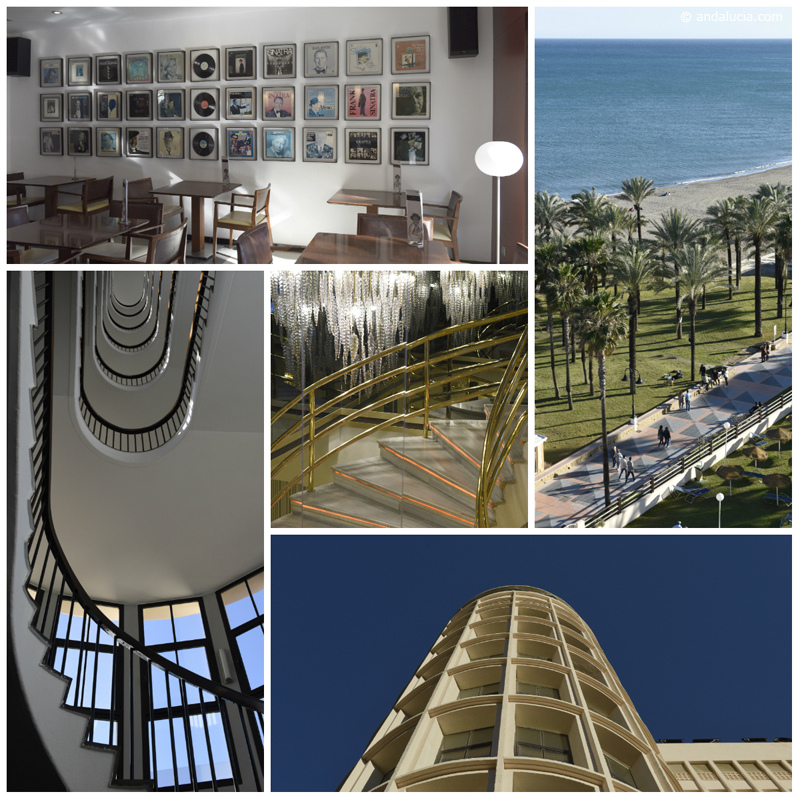
 The historic Pez Espada Hotel in Torremolinos
Torremolinos History
The ‘in place' of the 1950's and the Hotel Pez Espada.
by Chris Chaplow
.........continued from Pre-history, Moors, Catholic Re-conquest, and 20th
In the 1950s the French invented the "Petit Tour", which was the long and arduous overland route by train to Málaga and then along the pretty Costabella (while examples of the name Costa del Sol did exist in print at this time, it was not in general use) via Torremolinos, Marbella and Gibraltar to Tangier and perhaps Marrakesh. Thanks to some celebrity press coverage, wealthy Americans came to check out the "in place" called Torremolinos as part of their European tours.
Whereas other parts of seaside southern Europe such as Nice on the French Riviera (Côte d' Azur), Portofino on the Italian Riviera, Biarritz and San Sebastián on the Atlantic coast were already functioning as tourist resorts, the potential of Torremolinos with its low land cost was not unnoticed. However, the main problem was that it was two uncomfortable days of train travel further away.
Nevertheless, there was a convenient air base in Málaga. "El Rompedizo" was its name, after the farm it on which it was built. Located between Torremolinos and Málaga, it existed thanks to an Air Poste refuelling stop for French aviators travelling from Paris to Buenos Aires. From this a Spanish military air base was established. On 12 July 1946 the Málaga air base began to offer national and international scheduled flights and in 1948 dedicated civilian passenger facilities were opened. (See Málaga airport History).
In the 1950s, famous celebrities began to visit: Rita Hayworth (1950), Grahame Green (1953), Lord Halifax (1955), Ava Gardner (1955) and Grace Kelly (1956).
Brigitte Bardot (1957) filmed "Les bijoutiers du clair de lune" (The Night Heaven fell) in Torremolinos and El Retiro. The film, which included naked scenes, was banned in Spain for several years before a public outcry forced an edited version to be released. Off the set Bardot rode a donkey taxi and tried out bullfighting in Mijas, walked the Caminito del Rey, and found time to visit Prince Hohenlohe in Marbella Club hotel. Bardot chose the beaches of Torremolinos over Marbella to top up her tan, much to the dismay of the locals of La Carihuela. They wrote to Pedro Luis Alonso, the mayor of Málaga, to complain about her "immoral behaviour and attitude", and he publicly called for her deportation. Surprisingly, she was not offended by this and always spoke well of Torremolinos. She returned in 1971 to film El boulevard du Rhum (Rum Runners), and a street and a mural in Plaza Costa del Sol were named after her. She was also featured on the 2024 Feria poster wearing a Córdoba hat. A collection of 61 photographs taken during filming in 1957, titled 'Bridgette Bardot: Myth and Clichés', were exhibited at the Thermica in Málaga and at Torremolinos Town Hall in 2021. The collection of photos by an unknown author or authors were purchased in a French auction as 6cm by 6cm contact prints.
Jean Cocteau (1960), staying at Hotel Miramar, was arrested for doing "something" with a fisherman behind a boat on the sand, according to Don Lorenzo's account. Marlon Brando and Orson Welles also visited, and all this publicity helped spread Torremolinos's increasingly famous name and reputation.
The English tour operator Horizon chartered a Vickers Viking, named 'Amy Johnson', which was operated by BKS Air Transport (which later became part of BEA, and then British Airways). The flight left London at 3 am on 18 May 1956 with 30 tourists on board. After refuelling in Bordeaux, it landed in Málaga at 10:30 am, where it was warmly greeted by dignitaries from the Ministry of Tourism and Information. That year, 850 international passengers travelled through Málaga Airport.
From May to December 1957, a 1,800-metre concrete runway was constructed. After further land expropriations to the north, it was extended to 2,000 metres on 1 November 1958. This enabled the arrival of a Convair 440 Metropolitan aeroplane on 20 October 1959, the first operated by the Finnish company Kar Air from Helsinki, which was advertised as the 'Ruta del Sol'. The passengers certainly endured it, with refuelling stops at Gothenburg, Basel and Barcelona. Meanwhile, Boeing was selling its 707 jet airliner to European airlines and plans were already underway for the 3,200-metre Málaga runway that this jet required. On 21 January 1962, a SAS Caravelle jet performed a test landing in preparation for a direct flight from Copenhagen.
During the 1960s, package holidays became popular in all northern European countries. Due to economies of scale, holiday prices dropped, which in turn fuelled soaring demand. Mallorca was at the forefront of this trend.
El Bazar Aladino, the avant-garde commercial centre that looks like a boat, was opened in 1953 by architect Fernando Morilla - and it remains a curiosity to this day.
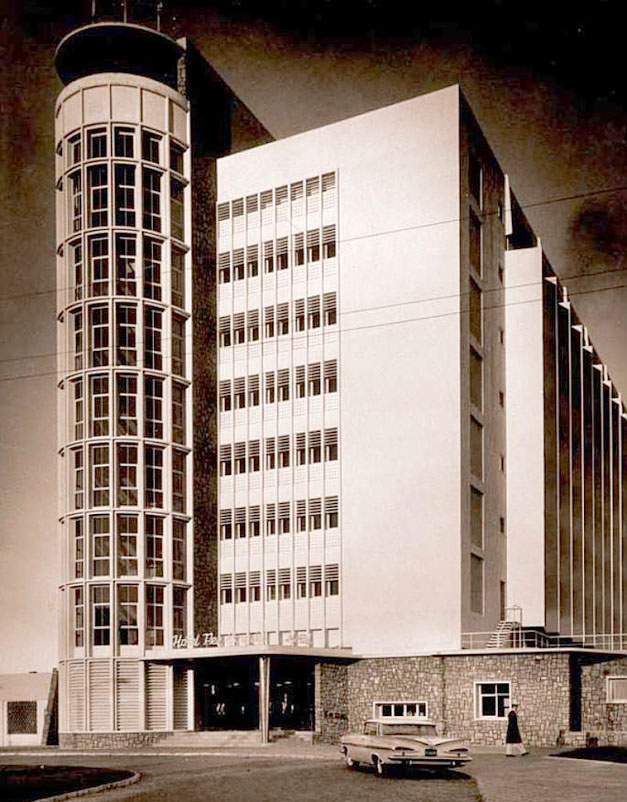 The Pez Espada hotel Torremolinos in 1959. (c)MedPlaya
HOTEL PEZ ESPADA
The luxury five-star Hotel Pez Espada opened on 31 May 1959. From that day onwards, it has been an iconic hotel, and no history of the Costa del Sol or Torremolinos would be complete without reference to its illustrious guests, events and galas. Promoted by Madrid businessmen Luis Mato and Juan Aberola and designed by architects Juan Jáuregui Briales and Manuel Muñoz Monasterio, it was a remarkable project from the outset. Many laughed at the idea of building a five-star hotel on the beach during construction, but it marked a turning point in tourism. Read a more detailed history of Hotel Pez Espada.
Six hotels were opened in Torremolinos in the six years prior to the Hotel Pez Espada inauguration; about 55 were opened in the six years following it.
This rapid evolution was not only due to market forces, but also to a conscious decision taken in Madrid. Gabriel Arias-Salgado was the first and only Minister for Tourism and Information since the role was created in 1951. He and General Franco recognised an opportunity to acquire much-needed foreign currency.
Spain's first urban planning law was introduced in 1956, requiring local councils to produce local urban plans for Madrid's approval. These measures were slow to be adopted, and in any case, they were considered subordinate to other economic or national plans and initiatives. It was not until 1975 that the second urban planning law was improved, and no specific coastal protection law was introduced until 1987.
It is also important to understand that up to this point Gibraltar airport had been the main flight access to the Costa del Sol from the west. Marbella was the central point, with tourist hotels such as Marbella Club and Hotel Fuerte opening in 1954 and 1957, respectively. GB Airways operated a daily flight from Gibraltar to Málaga.
The Hotel Pez Espada provided accommodation for famous Hollywood actors and actresses. Many came to Torremolinos, either to visit the town or because they were filming nearby.
Dirk Bogarde and John Mills in the "The Singer not the Song", filmed in Alhaurín in 1961. Frank Sinatra stayed in 1964 while filming "Von Ryan's Express" in El Chorro. Anthony Quinn and George Segal visited in 1966, filming scenes from "Lost Command" and using Málaga port as a location, while most of the film was shot in Almería. Raquel Welsh visited in 1967 when filming "Fathom", but the famous walking down the steps in a yellow bikini scene was shot in Nerja not Torremolinos.
Continued....... The tourism growth of the 1960's and 1970's
