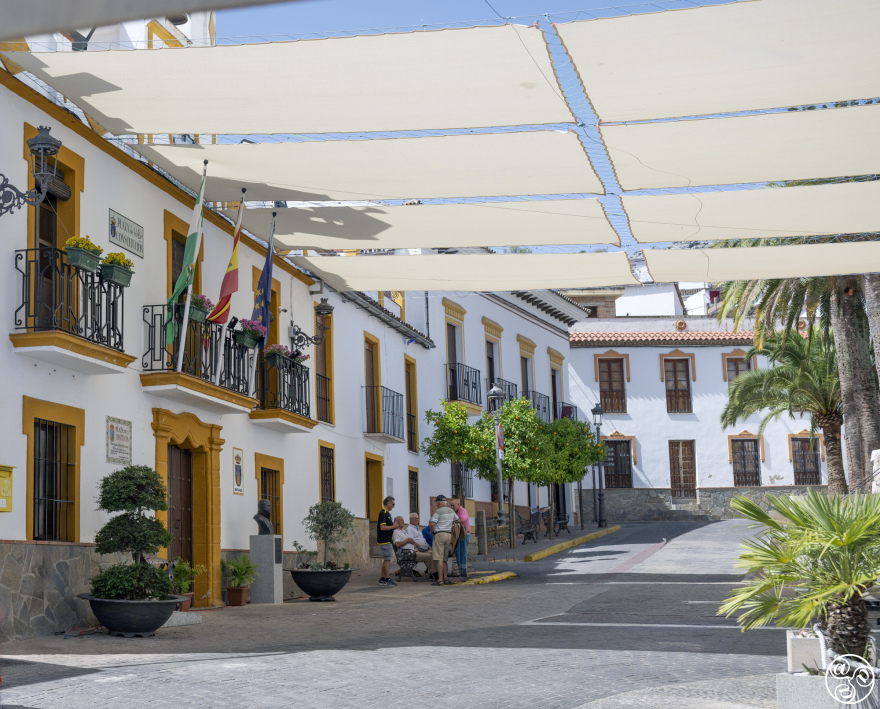
 Plaza de Andalucia. Montejacque
Montejaque
As in all the pueblos blancos, Montejaque dates from the time of the Berber settlers, after the Muslem conquest. Located in a natural bowl hidden by circular rocky outcrops, it overlooks a small fertile valley of olive groves. Montejaque has a population of 1,000 people.
History
Many homes were abandoned and fell into disrepair as the population left, firstly for Ronda then further afield. Indeed a plaque in the village commemorates the constant exodus of people, initially in the 17th century, to colonise America and in more recent times to Holland in search of work. The ever-expanding Costa del Sol still attracts the young away. More>
Arriving at Montejaque
The village centre and Plaza de la Constitution can only be approached by one short no through village road, having left the Cortes-Montecorto M-8402 country road and turn into the village driving along Avenida de Andalucia. Parking is not easy to find and it becomes more difficult the further you go, so the sooner you park the better on Avenida de Andalucia or one of the lower side streets. If you accidentally do reach Plaza de Andalucia then use the water-shoot central fountain as a roundabout and drive straight back out again. There is usually parking space in the old cemetery on the higher Avenida de Europa, and failing that there will definitely be a place or the higher still, Calle Libar. Thursdays are a good day to visit as it is market day but parking is even more difficult. After parking it is a short walk to Plaza de Andalucia where you can stop in a bar to rest and take your bearings.
Things to See in the Village
The Plaza de Andalucia is dominated by the Parish Church of Santiago El Mayor built on the foundations of the mosque. Remodeled by Don Pedro Diaz de Palacios, the architect of Malaga Cathedral in 1604, the church did not remain untouched, as it was once again enlarged and re-dedicated in 1773. It has a large central nave and was built in the late Gothic style, with a vaulted roof covering the presbytery.
Also in the Plaza de Andalucia is the Old noble mansion house, which today is the three star Hotel Palacete de Marara. During the 17th century, this mansion was the seat of power for the Conde de Benavente and was used when he visited his domain to collect taxes and hunt on the then wooded mountain slopes. The family arms, carved in sandstone and rather decayed, can still be seen outside the main door of the building. The house was to see sadder times in the first half of the last century, when it became a sausage factory. This closed in 1995 due to changing EU legislation, when the owners could no longer meet EU regulations. At the end of 1998, the noble's palace was converted into a three star hotel, with Entre Ascuas, good restaurant serving local dishes. Either side are tapas bars Bar La Melli and Caniche. All three benefited from the remodeling of the plaza in mid 2010s with the removal of the narrow pavements, prohibiting parking and addition of a modern style water-shoot fountain which is always popular with young children until they receive an unexpected drenching.
Also sited in the Plaza de Andalucia, the Casa de Constitution was rebuilt in an interesting style after the Civil War. The original was an obvious candidate for attack during that bleak period, when authority was attacked by both left and right sides.
The Barrio Nazari (Moorish quarter) refers to the origins of the upper part of the village with its charistical narrow winding streets that cars can not enter. A Castle was located behind this area was destroyed after the re-conquest and many of the surviving walls were remodeled into homes.
Centro de Interpretación de la Espeleologîa (Speleology Interpretation Centre) is worth visiting if are lucky enough to catch it open during you visit to Montejaque.
There is a municipal swimming pool located in the new part of the village below Avenida de Andalucia at Terreno UR-1, 3B. Open summer only, noon to 19.00 hrs Tuesday to Sunday.
Restaurants
As well as the three mentioned above in Plaza de Andalucia, also centrally located is the rustic Restaurant La Gruella Montejaque on Calle Cardenal Herrera Oria, 5 and several on Avenida de Andalucia namely Restaurant Atillo, Avenida Andalucía, 63 and nearby for drinks not food Copas HV at Avenida Andalucía, 71.
Things to see walking outside the village
Mirador del Karst,
Above the village is the Mirador del Karst (also called Mirador del Castillo) a viewpoint and picnic table area with 360 views over the village rooftops and incredble views over the surrounding mountains. Stand in the centre of the Plaza de Andalucia and look up over the rooftop of the Town hall (Casa de Constitution) and you can see a wooded handrail on the top of the hill, this is the Mirador del Karst. It is a very peaceful place. Take a drink and snack with you. access from Calle Castillo and keep going up, it is about 500 meters uphill from the Plaza but manageable taking your time. A karst is a unique land type formed when slightly acidic rainwater slowly dissolves soft bedrock, key examples including sinkholes, caves, and underground streams. the mountains around Montejaque are Kartic and this is the best place to see them all around. More about Karst Landscapes.
There is a track crossing the M-8402 called the Camino de Grazalema which is still used today and passes the Hermita de Montejaque (or Hermita las Escariguelas) which is visited every August by a procession in honour of the village's patron saint, the Virgin of the Conception. Not an easy task when carrying a statue as the Camino de Grazalema rapidly climbs Zig-zag more than 300 feet. Beyond the hermitage is the pass and a panoramic view of Ronda in the distance. The old medieval road led down into the valley below. Serious walkers follow a route that follows the crest to the left and terminated at the highest point (Mures, 870m above sea level). This track then drops down to the road, very near the empty Reservior de Montejaque.

Things to see near Montejaque - driving from the village
Reservior de Montejaque, Dam of the Caballeros and Cueva de Hundidero
Dolmen El Gigante - Neolithic burial chamber
The Valley of the Republicans (Hacho)
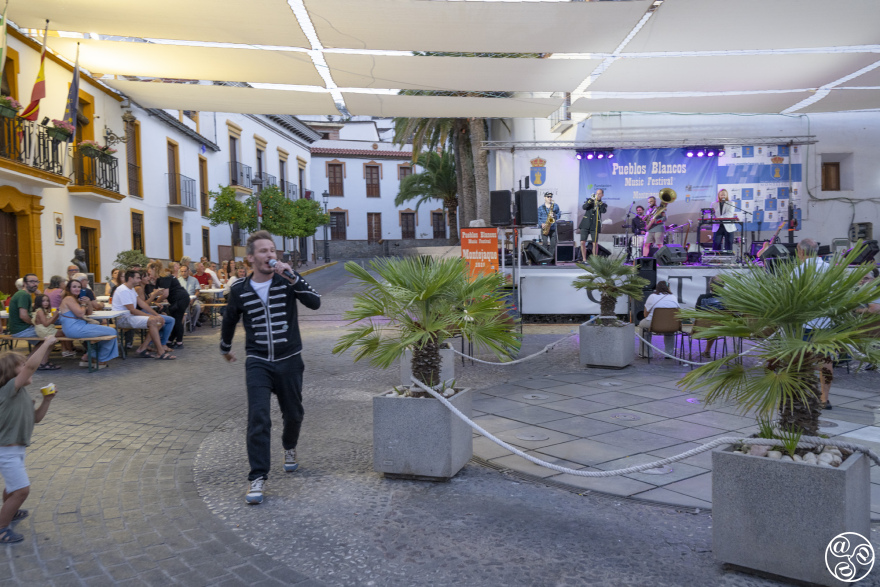 Pieter, frontman of the Belgian band Zinger in Montejaque
Festivals
The village celebrates its various feast days on the 17 May, 25 July and 15 August.
Montejaque is the heart of the Pueblos Blancos Music Festival, where the artists call home for the weekend and locals spill into the town square to feel the music. It’s the place to be on last Sunday in July, the grand finale night of the fiesta. The plaza comes to life as the sun sets over the white hills of Montejaque. Terraces fill and the bars pack with patrons. It feels as though the entire village has woken up and turned out to the square. If there is one night to see this festival in Montejaque, it is on the closing Sunday. More >
Walking guide books by Guy Hunter Watts
Buy walking guide books by Guy Hunter Watts
"Walking in Andalucia" by Guy Hunter Watts
 Walking in Andalucía is a 260 page full colour guide to some of the very best walks in southern Spain, taking the walker on 34 routes - all starting and most finishing in beautiful villages - in the Natural Parks of Grazalema, La Alpujarra, Cazorla, Los Alcornocales, Aracena, and La Axarquia. Many of the full and half day walks are virtually unknown even though they are a short drive from the Costa del Sol. Even though more and more people are beginning to walk Spain's southern sierras, most of the routes remain blissfully undiscovered. Guy says, 'If you decide to head for the hills with my guide you can be sure of two things: you will be walking through areas of great natural beauty and you will meet with other walkers.'
Buy a printed or eBook copy online direct from publishers Walking in Andalucia.
"The Andalucian coast to coast walk " by Guy Hunter Watts
 A stunning 21 day, 435 kilometre trail that links the Mediterranean with the Atlantic. The walk passes through six of Andalucia's Natural Parks and protected areas via its most beautiful mountain villages. Far more than a long walk, this on-foot odyssey can lead you to the heart of southern Spain's magnificent sierras and on a life-changing journey of discovery. One of the best things about the simple act of walking is the sense of reconnecting with Nature and the Big Wide World. We've been moving around on two feet for a very long time yet still, in the simple act of putting one foot in front of the next and moving across landscape, it seems that we reassert our identity. Day to day worries fall into insignificance, or rather true significance, when we get out into the mountains and walking is about a lot more than taking exercise.
Buy a printed or eBook copy online direct from publishers The Andalucian Coast-to-coast Walk.
"Walking the Mountains of Ronda and Grazalema" by Guy Hunter Watts
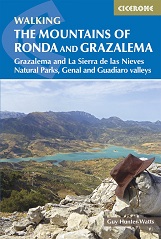 The dramatically situated town of Ronda can make a great base for a walking holiday in the mountains of Andalucía, as can any one of the picturesque 'pueblos blancos' (white villages) that nestle among the surrounding hills. This guidebook presents 32 mainly circular walks in the Ronda region, covering the town and its environs, the Natural Parks of La Sierra de Grazalema and La Sierra de las Nieves (both UNESCO biosphere reserves), and the Genal and Guadiaro Valleys. Clear route description is illustrated with mapping, and the route summary table and 'at a glance' information boxes make it easy to choose the right walk.
Buy a printed or eBook copy online direct from publishers Walking the Mountains of Ronda and Grazalema.

