Backpacking in Ronda
by Lee Gutcher
The Pueblos Blancos, or white towns are places of great beauty. Set in rural mountainous terrain each town offers spectacular picturesque views. The most famous of these white towns is Ronda.
The best way to appreciate the White Towns is by car. Winding along the mountainous roads any route provides great reward and beautiful scenery. Watch out for other Pueblos Blancos such as Gaucin, Casares, and Jimena de la Frontera. Without a car these places would be difficult to get to, only Ronda has good transport links. Taking the train to Ronda from Algeciras is the best method of entry.
Ronda itself is built on an isolated ridge and split by a huge gorge of over 100m. The gorge is spanned by a breathtaking bridge, which claimed its creator's own life as he peered over to admire his work. It is the stunning mountain scenery and natural beauty which pulls in the masses of tourists, and few leave disappointed.
The maze-like town itself is a pleasant stroll. You might also want to descend the hundreds of steps to the bottom of the gorge from the Casa Del Rey. There are also some well preserved 13th Century Arab Baths on the riverbank.
The Plaza de Toros is certainly worth a visit. You can stroll at will around the oldest bullring in Spain. It was here where modern bullfighting developed, all of which is explained in the excellent free information guide. There is also a museum with costume and some rather bloodthirsty pictures.
Hostals and Hostels in Ronda
Book hostals and hostels


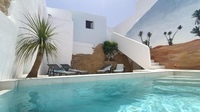
See the Ronda home page.
Things too see
- Bullring Ronda. Inaugurated in 1785, Ronda's Plaza de Toros is one of the oldest in Spain, younger and smaller than that at Sevilla, but home to one of Spain's most famous 'schools' of bullfighting. More>
- Iglesia Espiritu Santo. Towering above the Almocábar gate, the monolithic church of the Holy Spirit is the Ciudad's unofficial cathedral, and certainly the place where the señoritos and their ladies from Ronda's old families can be seen at Sunday mass. More>
- Convento de Santo Domingo. Built on Arabic foundations at the instigation of the Reyes Catolicos after the fall of Ronda in 1485, this imposing structure on the far side of the Puente Nuevo has been rebuilt over the centuries in Mudejar (post-Reconquest Arabic), gothic and Renaissance styles. More>
- Casa del Rey Moro. The Casa del Rey Moro is to some extent a fraud, since the house was never the home of the Moorish King. It was built in the 18th Century, when Moorish Spain was already a distant memory. More>
- Puente Viejo. Built in the 16th century, possibly on remnants of an earlier bridge, this was the one navigable link between Mercadillo and La Ciudad until the completion of the Puente Nuevo centuries later. More>
- Palacio del Marques de Salvatierra. Across the cuesta from the Casa del Rey Moro, the Palacio of the Marqués de Salvatierra family opens irregularly as a small museum of Renaissance art and artefacts. More>
- Alameda del Tajo. The Paseo Hemingway leads on to Ronda's great green lung, the 19th century Alameda del Tajo. Originally named the Alameda de San Carlos, this is the front garden for a town where nobody has a front garden. More>
- Spectacular Balcony of Paseos. Behind the Plaza de Toros are Ronda's spectacular walkways celebrating two famous visitors, the Paseos de Ernest Hemingway and Orson Welles, both great aficionados of the corrida and just two of the stellar international figures who became associated with Ronda over the years. More>
- Puente Nuevo. Puente Nuevo, Ronda's 'new bridge' was completed in 1793, after 40 years in construction and after the loss of the lives of 50 builders constructing the span bridging the 98m Tajo gorge. More>

Hover the cursor over Ronda to see bigger map and click to go to the maps page.