Córdoba

Shopping in Cordoba

There are plenty of ideas to choose from, including local pottery, to decorate your home, the most fabulous silver jewellery, hand crafted leather work, Cordobese hats or you could even invest in your very own Spanish classical Guitar.

Cordoba City Cinemas

Informaton about the beautiful city of Cordoba, Andalucia, southern Spain. Cinemas in Cordoba.

Palacio de Viana

This Palace, which was declared a National Monument and important Artistic Garden, has a surface of 6,500 m2, more than half of which is occupied by the garden and the rest by a building with two floors and two little entresols.

Botanical Garden

The hothouse has 130 plant species from the Canary Islands, divided into three areas by climate: moist such as geranium; desert plants, such as spiny and succulent (cacti and aloes); and a diverse group which includes ferns and Cycads (palms and ferns), as well as many native Spanish plants, also found in the Andalucian mountains and the Balearic islands.

Getting there

The AVE high speed train links Cordoba with Sevilla (45min) and Madrid ( 2hrs) and also Antequera and Malaga. The RENFE station opened in 1994 and is located in the northwest of the city. More Cordoba station.

Cordoba City - Fascinating Fact 2 - Leather and whips

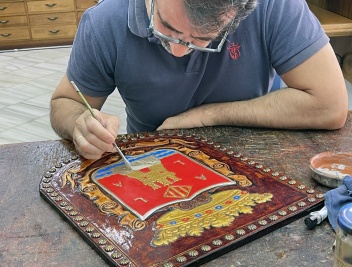
As well as the typical collections of archaeology, fine art and bullfighting paraphernalia, Cordoba also has some more unusual museums: leather art, patios and torture. The city is famous for its leatherwork, and its most historic technique, guadameci, is an intricate embossed design with gold, silver and coloured paint, unique to Cordoba, which dates back to the 10th century. /p>

Tower of La Calahorra

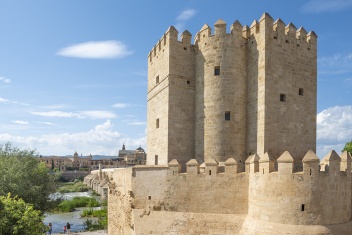
The Tower of La Calahorra rises up at the south of the Roman bridge, the far end from the city centre. It is a fortified gate originally built by the Moors (Almohads) and extensively restored by King Enrique II of Castile in 1369 to defend the city from attack by his brother Pedro I the Cruel from the South. It was origionally an arched gate between two towers. Enrique II added a third cylindrical shaped tower connecting the outer two.

Cordoba City Museums

Museums in Cordoba City: Museo de Joyerá Regina, Alcázar de los Reyes Cristianos, Museo Arqueológico, Museo de Bellas Artes, Museo Julio Romero de Torres, Museo Diocesano de Bellas Artes, Museo Monográfico Madinat Al-Zahra and more.

Puerto Del Puente (Bridge Gate)

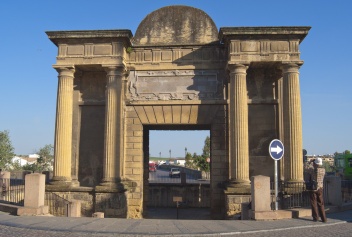
At the north end of the Roman bridge formerly used to enter the city enclosure near the Mosque, rises the Puerto del Puente or Bridge Gate. It was completed in the days of Philip II. The present triumphal arch is the work of Hernán Ruiz III and replaces what was first a Roman gate mentioned at the time of Julius Cesar and later a Moorish gate. A documented restoration took place in 720 AD. Today it is a traffic island.

City Walls

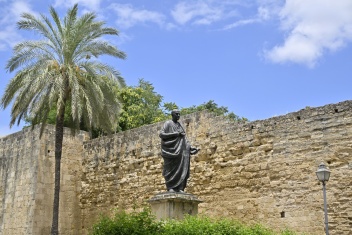
The walls which used to mark the boundaries of the Jewish quarter extended virtually to the Arab walls. The latter enclose the Alcazar gardens and continue along the river bank. These stretches of wall are among the better conserved in the city's fortified enclosure, although they are from a later period.

Bullfighting Museum

Located in the old Casa de las Bulas, a renaissance building in Maimonides Square. Photos of old bullfighters, their costumes and various regalia.

Plaza del Potro

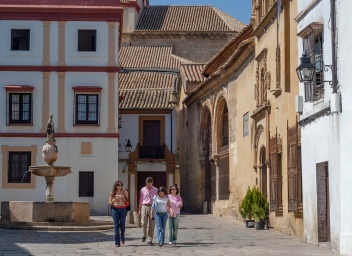
Just a few minutes away from the Mezquita, to the east along calle Luis de la Cerda/Lineros, is the Plaza del Potro (Square of the Colt), a long, rectangular square which slopes down towards the nearby Guadalquivir river to the south. It is named after the 16th-century fountain in the plaza (1577).