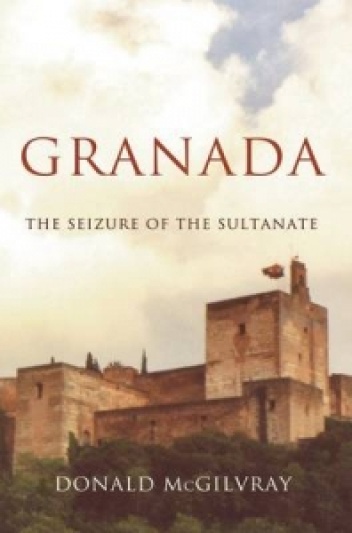
Granada, the seizure of the sultanate

A fascinating history of this pivotal point in Spanish and European history, this is an important new look at the conquest of Granada The sultanate of Granada was the last bastion of Islamic rule in Western Europe. Situated in the mountainous regions of Southern Spain, it survived and even prospered for over two and a half centuries and was then overwhelmed in less than a decade.

Andalucia by Michael Pauls and Dana Facaros

This title features: dynamic two-colour layout for clear navigation magazine style, combining stunning photography, itineraries and the authors' personal take on the country; extensive listings of hotels and restaurants - all personally visited and recommended top 'Don't Miss' sights at the start of every chapter, plus new 'Author Choices' of personal favourite places to stay and eat clear, designed two-colour maps throughout for increased ease of use and, the only guides with full-colour touring maps of the whole region.

South from Granada by Gerald Brenan

Between 1920 and 1934, Gerald Brenan lived in the remote Spanish village of Yegen and "South from Granada" depicts his time there, vividly evoking the essence of his rural surroundings and the Spanish way of life before the Civil War. Here he portrays the landscapes, festivals and folk-lore of the Sierra Nevada, the rivalries, romances and courtship rituals, village customs,

Andalucia by Michael Jacobs

In this masterly book, now in a revised and updated fourth edition, Michael Jacobs looks with fresh eyes at all the traditional delights of Andalucia while doing full justice to the lesser-known aspects of the region. He examines the underrated local food and drink, the extraordinarily varied natural scenery, the composers and writers who created the romantic myths and legends of the nineteenth century, the strange legacy of Lorca and the Spanish Civil War.

Between Two Fires by David Baird

For long the subject was taboo. Now a new books throws fresh light on a forgotten war that raged in the 1940s and early 1950s in the mountains of Spain. Entitled Between Two Fires - Guerrilla war in the Spanish sierras, the book appears at a moment when Spain is involved in intense and often bitter debate about its recent past under the 40-year Franco dictatorship.

Ghosts of Spain by Giles Tremlett

The Spanish are reputed to be amongst Europe's most voluble people. So why have they kept silent about the terrors of the Spanish Civil War and the rule of dictator Generalisimo Francisco Franco? The appearance - sixty years after that war ended - of mass graves containing victims of Franco's death squads has finally broken what Spaniards call 'the pact of forgetting'.

History & Cultural Books Reviews

Books about the history and culture of Andalucia: The Duchess of Rio Tinto by Martin Murphy, Granada, the seizure of the sultanate, Andalucia by Michael Pauls and Dana Facaros, South from Granada by Gerald Brenan, Andalucia by Michael Jacobs and more.

Architecture Roman

When the Romans invaded in the 1st century AD they proceeded to build whole towns and innumerable monuments, as well as roads, bridges and aqueducts. The two significant characteristics of their architecture are the arch and the dome, along with the sense of space and grandeur.

Mudejar & Romanesque architecture

The mudéjar style of architecture emerged in Andalucía during the 12th century as Romanesque, with its close links to France and Italy, spread through northern and central Spain. The style, unique to southern Spain and lasting into the 16th century, flourished in each region as it was reconquered by the Christians.

Gothic & Renaissance

Classic Gothic architecture, overlapping with the mudéjar style, spread through Andalucía from the 14th century with the Reconquest. As the Christians recovered the towns and cities there was a big movement to build churches. The design is characterised by vertical lines, lofty pointed arches and high ceilings.

Baroque & Neoclassicism

Baroque and Neoclassic architecture was prominent in Spain between the late 17th and mid 18th Century. These two styles were not as influenced by the Muslim world as the majority of Andalucian architectural styles. Baroque dates back to the late 17th century and reached a peak in the 18th century. Andalusia was one of the places where Baroque blossomed most brilliantly.

Baroque dates back to the late 17th century and reached a peak in the 18th century. Andalusia was one of the places where Baroque blossomed most brilliantly.

Muslim

The horseshoe arch, first seen in small churches erected by the Visigoths, was developed by the Moors and became the hallmark of their architecture; the Grand Mosque in Córdoba being the classic and most well known example. Other design characteristics brought from Syria by the Umayyads in the 8th century were plant motifs and decorative inscriptions of calligraphy running horizontally across walls or around doorways.

History

When people think of the history of Gibraltar they often think in terms of the bloody 18th century sieges when Spain tried to regain the Rock from the British. However, the history of Gibraltar very much reflects that of the Mediterranean and it could indeed be argued that it reflects that of man himself.

History of Andalucia

An historical overview of Andalucia from the prehistoric beginnings through the Romans and the History of Spain, Jews in Spain, Moors, through the Dark Ages, the Reconquest, Christian rule, Christian rule, Spain's First Constitution, the Bourbons to Andalucia moves with Europe.

The Story of Spain by Mark Williams

Mark Williams takes the reader through the history of Spain in a descriptive way, unravelling the history of what he portrays to be Europe most fascinating country. The first page introduces us to the Romans in Spain and traces the reader through important topics such as Medieval Spain, Moorish Spain, the Spanish War and the Age of Franco.

Moors & Christians festivals

This festival is more popular in the east of Andalucia in the mainly provinces of Granada and Almeria, It takes place on different many days through out the year depending on the locality.