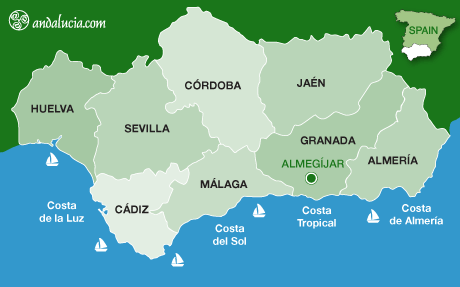
Almegíjar
It seems as if time has stood still in Almegíjar, where the streets remain much as they were during the Muslim dynasty when the village was first established. The narrow, steep streets and traditional houses made of materials such as slate have not changed in centuries. The village has a population of around 340.
HISTORY
The origin of the town dates right back to the Neolithic era, having found objects in the municipal area dating to the settlement. Romans and Visigoths passed through these lands also, but, without a doubt, it was the Arabs who shaped its current image. More>
THINGS TO SEE
Fuente de los Seis Cantos
The masonry fountain has six spouts and is covered in lime plaster that creates the appearance of false ashlars. Six limestone blocks are arranged horizontally on the masonry, forming hollows called cantareras in which jugs were placed to fill them with water. It is believed to be of Arab origin. It is located on Calle Daniel Noguerol.
Lavadero de las Pozas
The washing place is made of plastered masonry and limestone ashlars. It is rectangular in shape and divided into three similar-sized portions, each of which takes the form of a pool for collecting water. On both sides of these small pools, there are pieces of inclined limestone ashlars used for traditional washing tasks. It is located on the Paseo de los Tristes.
Iglesia del Santo Cristo de la Salud
The original church, which was built in the first third of the sixteenth century and featured an altarpiece by Pedro Machuca, was destroyed during the Alpujarras revolt. It was rebuilt between 1594 and 1597. More>
THINGS TO SEE OUTSIDE THE TOWN
Conjunto Enclave de la Mezquita
This complex comprises several features, including the archaeological site of La Mezquita, the remains of a mill, and the Baños de Panjuila baths. More>
NATURAL AREAS
Almegíjar has a distinctive natural environment comprising several vertical cliffs that are ideal for climbing, as well as a mountainous landscape that is perfect for mountaineering.
Barranco de La Toba: This is a very attractive landscape with a gallery forest of high ecological value containing poplars, wild rose bushes and brambles. It is located in the south-east of the municipality.
Cerro La Solana is a mountainous area with limestone outcrops. At the top is the Cueva Chimeneón. The area is dominated by low scrub, including esparto grass and rosemary, and offers magnificent views of the Sierra Contraviesa. It is located west of Almegíjar.
Cueva del Moro: A large limestone rock on which the Tajo del Cerro de La Cruz is located. This cave may be connected to the Raja del Moro, which opens up the possibility of practising speleology.
Raja del Moro: An area characterised by a deep and spectacular fissure that extends into the interior. Low-impact sports such as climbing can be practised here and it is located next to Cerro de la Cruz.
Rambla de la Barbacana: A ravine framed by two steep hills where you can find a gallery forest and scattered oak and almond trees. It is located in the Sierra Contraviesa.
Tajo del Cajelón: A limestone rock with very vertical walls where you can climb. The vegetation consists of broom, heather and olive groves. It is located between Almegíjar and Notáez.
Tajo del Cerro de La Cruz: A limestone wall of great height and verticality, suitable for climbing.
Tajo La Calera: A vertical limestone wall in an area dominated by scrubland. It is located in the northern part of the municipality.
HANDICRAFTS
As in many other villages in the Alpujarra area, Almegíjar has a rich tradition of local crafts. The tradition of pottery making in the village continues with the production of ceramic products.
BUS SERVICE
There are no bus services from Almegíjar.
GASTRONOMY
The richness of Alpujarra cuisine owes much to the coexistence of Arab and Christian cultures, indigenous culinary customs that have been faithfully preserved thanks to the peculiar geographical location of this area of low temperatures and difficult access. Along with the popular migas and gachas, gurullos, pucheros, potajes and the consistent Alpujarra dish, in addition to the delight of sausages, game meat and pastries in which almonds and honey are present. Dishes worth trying include migas (fried breadcrumbs with pork), fritaíllas (vegetables rabbit or pork), albóndigas de bacalao (cod meatballs), puchero de hinojos (fennel stew) and olla de San Antón (chickpea stew). Sweet treats include pan de higo (fig bread), torrijas de leche (eggy bread) and leche frita (fried custard).
FESTIVALS
Popular festivals in Almegíjar are Fiestas de Santo Cristo de la Salud, San Marcos and Fiestas de la Virgen de la Cabeza. More>
WEATHER FORECAST
The weather forecast for the next few days for Almegíjar. More>
TOURIST OFFICE
The tourist office of Almegíjar is located in the Town Hall. More>
NEARBY PLACES
The neighbouring villages to Almegíjar are Torvizcón and Notaez.