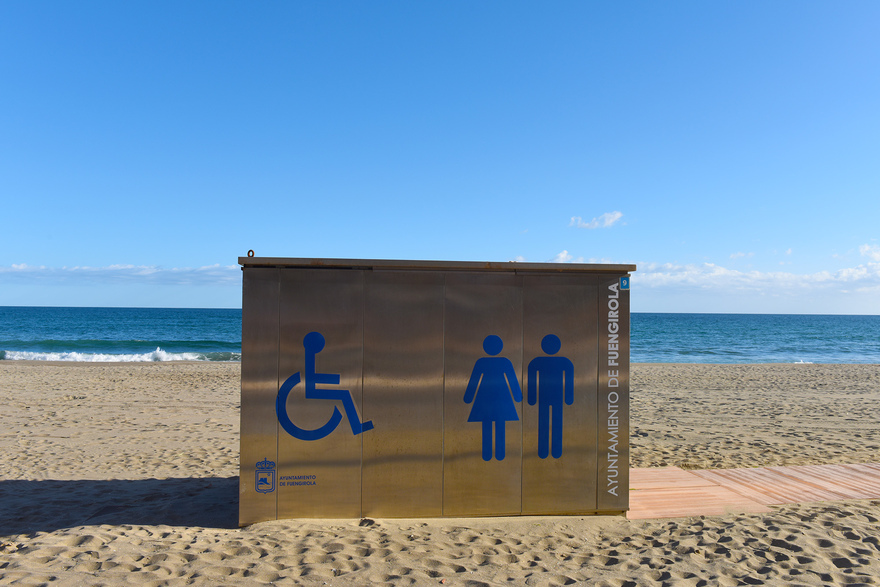
 Accessible toilets, several beaches are adapted for bathers with disabilities and wooden boardwalk
Disabled Facilities for Travellers to Andalucia
Traveling to Andalucía with mobility issues requires a bit of forward planning, but the region has made significant strides in accessibility in recent years. While the historic, cobbled hearts of cities like Seville and Granada can present challenges, modern infrastructure and specialized services are widely available.
Here is a brief guide to navigating Andalucía comfortably.
Arrival and Transport
Airports: Málaga-Costa del Sol Airport is highly rated for its assistance. There are official "Meeting Points" throughout the terminals where personnel can assist you. You can arrange this service in advance via the Aena website or by calling (+34) 913 211 000.
Trains: The Spanish rail network, RENFE, offers a free assistance service called Atendo. This service helps passengers with reduced mobility navigate stations and board/disembark trains. Major stations like Málaga María Zambrano are entirely accessible and feature specialized seating and restroom facilities.
Public Transport: Most modern city buses in cities like Málaga, Seville, and Granada are equipped with ramps. In the Costa del Sol, look for "Eurotaxis"—specially adapted vehicles that can accommodate wheelchairs.
Accessible Monuments and Sightseeing
While the steep hills of the Albaicín in Granada or the narrow lanes of Seville's Santa Cruz can be tricky, the major monuments are increasingly inclusive:
The Alhambra (Granada): The Alhambra has a specifically designed route for wheelchair users. It covers the Nasrid Palaces, the Palace of Charles V, and the Generalife Gardens. It is recommended to enter through the main entrance near the ticket office, which is served by accessible buses from the city center.
Mezquita-Catedral (Córdoba): The Mosque-Cathedral is largely flat and accessible to wheelchair users, though some areas may have minor steps where ramps are provided.
Alcazaba of Almería: This fortress offers partial access. For the best experience, call ahead (+34 950 801 008) to arrange access to the "Third Enclosure" via the moat entrance, which bypasses some of the steeper climbs.
Vías Verdes (Greenways): For those who enjoy the outdoors, Andalucía has several Vías Verdes—disused railway lines converted into flat, paved paths. The Via Verde Olula del Río in Almería is a prime example of a wheelchair-friendly route through beautiful scenery.
Beach Accessibility
Andalucía’s coastline is famous for its "Blue Flag" beaches, many of which offer excellent disabled facilities. Key features to look for include wooden boardwalks, amphibious chairs (sillas anfibias) for entering the water, and adapted toilets/showers.
Costa del Sol: Beaches like La Malagueta in Málaga and Playa del Padrón in Estepona are well-equipped with ramps and specialized assistance during the summer months.
Costa de la Luz: In Cádiz, Playa Punta Candor (Rota) and Playa de la Cachucha (Puerto Real) are noted for their high level of accessibility.
Accommodation Advice
Hotels in Andalucia must comply with regional accessibility laws—governed primarily by Andalusian accessibility regulations (such as Law 1/1999 and Decree 293/2009) alongside baseline hotel decrees. These rules require barrier-free entry, accessible multi-floor elevators, adapted public restrooms, and a designated quota of fully fitted accessible bedrooms equipped with visual and acoustic emergency systems.
Hotels in Andalucia must offer adapted rooms based on their size (e.g., 1 adapted room for under 50 total rooms, up to 9+ for larger resorts). By law, these rooms cannot be booked by non-disabled guests until all standard rooms are occupied.
Always confirm the specific "adapted" features of a room before booking. Some rural properties, like Almond Hill House in the Alpujarras, have specifically renovated rooms (such as their 'Olive' suite) to be threshold-free with wide doors and ramps.
Car Parking
In Andalucian car parks, at least one reserved space is provided for every 40 standard spaces. If a car park spans multiple levels, accessible spaces must be placed on the level closest to the main exit or building entrance. These bays are strictly reserved for blue badge holders, marked with the International Symbol of Accessibility (ISA), and feature non-slip surface markings.
Entering Buildings
Tourist facilities are designed to be step-free at the entrance wherever possible. Where steps exist, you will find ramps, platform lifts, or elevators. Entrance doors provide a clear opening width of at least 80 cm with level turning space on both sides. Door handles are set at an accessible height (80–100 cm) and use continuous lever handles rather than round knobs for easy opening.
Moving Between Floors
Public buildings with more than one floor must provide step-free access alongside standard staircases.
Stairs: Feature non-slip steps, a minimum width of 1.2 metres, and handrails (often on both sides).
Lifts: Public multi-storey buildings are equipped with accessible lifts. Expect lowered control panels (max 1.2 metres high), Braille and raised lettering, high-contrast buttons, and visual/audio floor announcements.
Specialist Lifts: Where ramps or standard elevators aren't feasible, you may encounter permanent stairlifts or vertical platform lifts designed for independent wheelchair use.
Corridors and Common Areas
Hallways and internal pathways maintain a clear width of at least 1.2 metres. Flooring is firm, non-deformable, and slip-resistant under both wet and dry conditions. Doormats and carpets are flush with the floor or securely anchored to prevent tripping.
Public restrooms
Any venue providing public toilets must offer at least one fully accessible, unisex toilet facility designed for independent or assisted use by visitors with mobility requirements.
General Mobility Tips:
Cobblestones: Many historic centers use traditional stone paving. A wheelchair with larger, pneumatic tires or an electric attachment can make these areas much easier to navigate.
Discounts: Don't forget that many monuments and museums offer reduced entry fees for travelers with disabilities and their companions. Always carry your documentation or a "Blue Badge" to prove eligibility.
Pharmacy Services: If you need to rent mobility equipment (like electric scooters or walkers) locally, many large towns have ortopedias (specialized medical shops) that offer short-term rentals.
Tourist Offices
Many Spanish tourist offices at home and abroad carry information sheets, which while pretty basic, include some useful addresses for disabled travellers, together with details of accessible accommodation throughout the country.
