|
| Santa Justa train station in Seville |
TRAINS IN ANDALUCIA
By Fiona Flores Watson
The Spanish railway network was run by the state-owned company Renfe (Red Nacional de Ferrocarriles Españoles). Since 2005 the management of the infrastructure including tracks, signalling and stations is carried out by ADIF (Administrador de Infraestructuras Ferroviarias). In recent years, Renfe and Adif have made a tremendous investment in Spain's railway network, particularly in the new high-speed (Alta Velocidad Española, or AVE) rail system.

Book your direct and hassle-free transfer direct from Málaga Airport to your hotel or holiday-rental and return. Choose from minibus to private car with driver.

Trainline offers tickets to and from multiple destinations across Andalucia and Spain including the high-speed AVE train.
View Timetables and buy Tickets
- Seville-Malaga
- Seville-Cordoba
- Seville-Granada
- Seville-Antequera
- Seville-Madrid
- Seville-Barcelona
- Malaga-Madrid
- Malaga-Seville
- Malaga-Cordoba
- Malaga-Granada
- Malaga-Antequera
- Malaga-Barcelona
- Madrid-Malaga
- Madrid-Seville
- Madrid-Cordoba
- Madrid-Granada
- Madrid-Antequera
- Madrid-Barcelona
- Cordoba-Malaga
- Cordoba-Seville
- Cordoba-Granada
- Cordoba-Antequera
- Cordoba-Madrid
- Cordoba-Barcelona
- Granada-Malaga
- Granada-Cordoba
- Granada-Seville
- Granada-Madrid
- Granada-Antequera
- Granada-Barcelona
New low-cost, high-speed trains
Iryo
Italian operator Iryo launched its Madrid to Malaga via Cordoba and Antequera service and its Madrid to Seville via Cordoba service on 31st March 2023 with two trains a day in each direction. Trains are painted in a distinctive red livery.
Avlo
RENFE’s low-cost brand Avlo launched its Madrid to Malaga and Madrid to Seville service on 1st June 2023 with one train a day on each route in each direction. Later in the summer the Malaga route was increased to two a day in each directions. Intermediate stops from Malaga are Antequera Santa Ana, Puente Genil, Cordoba, Los Pedroches, Puertollano and Cuidad Real. Intermediate stops from Seville are Cordoba, Los Pedroches - Puertollano and Cuidad Real. The service comprises refurbished AVE units on one class painted in distinctive purple livery. The buffet car is replaced by vending machines.
Ouigo
On 16th January 2025 French SNCF operator Ouigo launch Madrid to Seville and Madrid to Seville and Madrid to Malaga service. The SNCF Euroduplex train units are distinctive ‘double decker’ units with 509 seats and a buffet service. The launch was delayed at least three times due to complication to adapt the units to Spanish ADIF signalling systems. Trains are painted white with distinctive large blue and red spot livery.
Free train tickets - 2022/2023/2024/2025
The 'free train tickets' (commuter) scheme was first announced in 2022, and is extended into 2025. These tickets, which are open to all nationalities, not just Spanish and residents, are an environmental measure designed to encourage commuters to use the train, thereby reducing CO2 emissions. This scheme was expected to be discontinued at end of 2024 but extended into Jan to April four-month period of 2025.
Anyone can buy a season ticket or a multi-trip ticket from RENFE for journeys between two specified destinations. For local trains (cercanías) the cost of the pass is 10€, and for medium-distance trains it is 20€. Once you have completed 16 journeys between the two cities within the four-month period the (10 or 20€) cost of the pass (season or multi trip ticket) is refunded. If you don't make 16 trips, the cost is not refunded. There are no free offers for ordinary single or return tickets.
Tarjeta Dorada card - Discounts for over-60s
This is a discount card that can be purchased by the over-60s and used to obtain discount on train tickets of 25% to 40%. The Tarjeta Dorada discount card may be purchased at train station ticket offices and travel agents and costs 6€ for one year. You must provide documentation to prove your age and should provide to show you are a Spaish resident such as Spanish ID Card (DNI), Foreign Resident ID Card (NIE) or Passport (mentioned in RENFE Terms and conditions as well). It may be renewed online 6€ for one, 12€ for two and 15€ for three years. It can be used on all AVE (high-speed), Larga Distancia (Long Distance), Avant (mid-distance high-speed) for a 25% dicount Monday to Friday and 40% at Weekends. It can be used on Regional trains (metric or Iberian gauge) and Cercanías (Commuter) trains for 40% discount every day. It may be purchaed at ticket office inmediately before pruchasing the train ticket if there is no queue for inmediate tickets.
Here we offer you a guide to Andalucia’s convenient rail network and ticketing system.
Train Stations in Andalucia
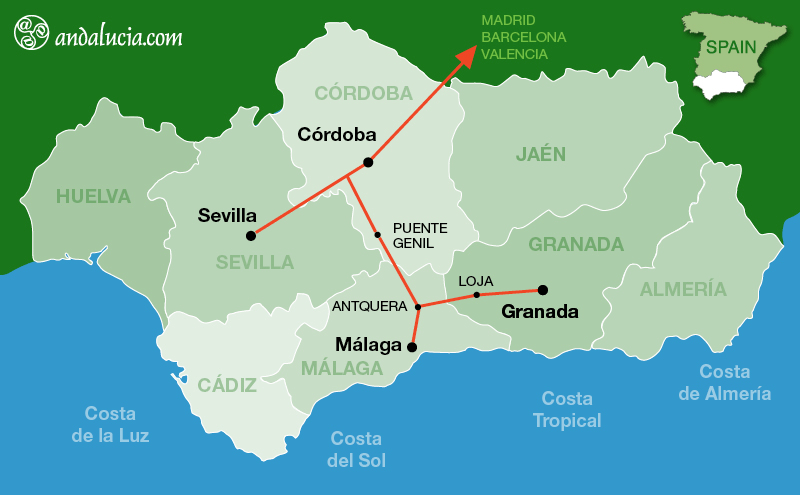
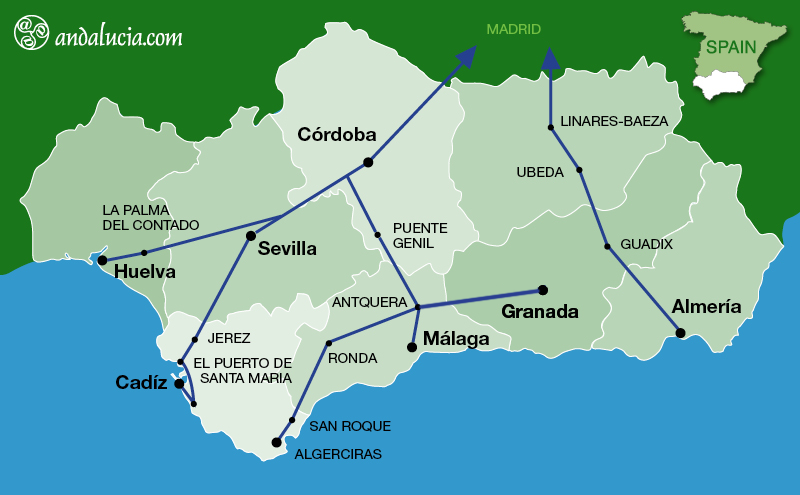
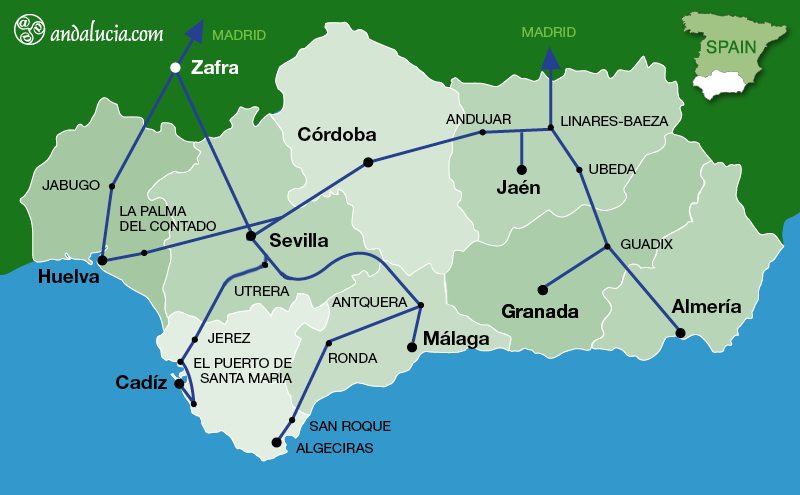
Here is a table which lists the AVE and other main train stations found in Andalucía.
| AVE Stations | Main Stations |
|---|---|
| • Seville Santa Justa | • Cadiz |
| • Cordoba | • Jerez |
| • Malaga Maria Zambrano | • Algeciras |
| • Granada | • Huelva |
| • Puente Genil-Herrera | • Almería |
| • Antequera Santa Ana | • Jaén |
| • Antequera Cuidad AV (opened 25 Jan 2023) | |
| • Villanueva de Cordoba - Los Pedroches | • Ronda |
| • Loja | • Guadix |
Book your direct and hassle-free transfer direct from Málaga Airport to your hotel or holiday-rental and return. Choose from minibus to private car with driver.
Trainline offers tickets to and from multiple destinations across Andalucia and Spain including the high-speed AVE train.
TYPES OF TRAINS
There are several modern metro systems in Andalucia in the cities of Sevilla (opened in 2008), Malaga (opened in 2014) and Granada (opened in 2017). The Tramvia link from Chiclana to Puerto Real… More →
These trains, which travel at about 75km/h. offer services into the cities Seville, Malaga and Cadiz from their suburbs and towns: Málaga to Fuengirola, Málaga to Álora, Seville to Utrera, Seville… More →
Medium Distance (MD) regional trains offer a network of routes between major cities and smaller provincial towns in Andalucia. The medium-distance services go under various names, the main… More →
Alvia is the name of high-speed services (though not as fast as the AVE) which connect the major cities of Andalucia with the Spanish capital, Madrid. Avant trains are fast (250km/h) medium-… More →
It is no exaggeration to say that the AVE (Tren de Alta Velocidad Española), which started in 1992 in time for Sevilla's Expo, changed the face of Andalucía. Suddenly, you could get to Madrid from… More →
TICKETS

Medium distance train
It is advisable to buy tickets in advance. This can be done on the RENFE website or by an online agent whose website is fully operational in English. Andalucia.com have affiliate partnered with Trainline for online RENFE and other operator tickets. You can also order tickets by phone, at the station itself, or at a RENFE appointed travel agent (small commission).
You can buy your ticket up to 60 days before your travel date. In the first two cases, you are either given a booking reference, which you then use to print out the tickets themselves from a machine at the main station, or you can print them out at home.
If you're travelling at the weekend or on a holiday or puente (long weekend), it is even more important to buy your ticket beforehand as the station may well be extremely busy, and seats may sell out.
If you're buying your ticket from the station on the same day you're travelling, arrive with plenty of time to spare, as queues can be long. Make sure you choose the right queue: if you're travelling within six hours, choose 'venta inmediata'; for further in advance, it's 'venta anticipada'. Also, you need to know which type of ticket you're buying. If you're sure you know what you're doing (type of ticket, service etc), you can even buy your ticket at an automatic machine.
Timetables and Tickets
Below are a selection of the most popular AVE train routes in Andalucia, click on the buttons to take you through to affiliate partner - The Trainline. Click on you route below, input your dates, check the timetables for your trains and if desired buy an eTicket with seat reservation.
View Timetables and buy Tickets
- Seville-Malaga
- Seville-Cordoba
- Seville-Granada
- Seville-Antequera
- Seville-Madrid
- Seville-Barcelona
- Malaga-Madrid
- Malaga-Seville
- Malaga-Cordoba
- Malaga-Granada
- Malaga-Antequera
- Malaga-Barcelona
- Madrid-Malaga
- Madrid-Seville
- Madrid-Cordoba
- Madrid-Granada
- Madrid-Antequera
- Madrid-Barcelona
- Cordoba-Malaga
- Cordoba-Seville
- Cordoba-Granada
- Cordoba-Antequera
- Cordoba-Madrid
- Cordoba-Barcelona
- Granada-Malaga
- Granada-Cordoba
- Granada-Seville
- Granada-Madrid
- Granada-Antequera
- Granada-Barcelona
FARES AND REFUNDS
Book in advance for the most economical fares; the best offers are online. Some services, including the AVE and fast long-distance services, offer a discount on the return leg of your journey.
Children under four travel free (under six on Cercanias), providing they don't occupy a seat; from aged four to eleven they get a 40% discount. If you have three or more children and live in Spain, you can apply for a "Familia Numerosa" card and obtain a 20 percent discount for all family members.
You can also find fares reduced by between 25 and 40%, for those aged under 26 years (Carnet Joven), or over 60 (Tarjeta Dorada, for Spanish residents).
Ticket costs may be partially or fully refunded if a train does not arrive on time, depending on the cause of the delay and how late the train arrives at its final destination. Be sure to save your proof of purchase, and if your train arrives late, ask a RENFE representative for more information regarding whether you're eligible for a refund and, if so, how to obtain one.
CLASSES
The faster trains (AVE, for example - see below) offer different classes (club, preferente, turista) compartments. First class offers reclining seat, refreshments served at your seat; while both classes have audio/video on AVE and fast long-distance services. All trains are non-smoking.
PASSES
Eurail Spain-Portugal pass offers five days of unlimited travel within one-month period.
PETS AND BIKES
You can take a small pet with you on the train (cats, dogs, birds, weighing up to 6kg, in a cage measuring maximum 65x35x35 cm). Only one animal allowed per passenger. The fare is 50% of the normal tariff. You can take your bike on trains, but subject to space available.
REFRESHMENTS
Most local and medium-distance trains will have snack and soft drink dispensing machine; the faster ones also have a cafeteria service, offering hot and cold soft drinks, alcohol, snacks and sandwiches.
Lost Property
Lost property found on trains or stations is kept by RENFE, Here is the lost property page on the RENFE website (in Spainsh) with contact details. RENFE the train operator use the ADIF (Stations operator) lost property system at https://www.objetosperdidosestaciones.adif.es/ You can also send an email to [email protected] Lost property is held for a month and official documentation handed to the police after 24hrs. Objects not claimed are placed in a public auction.
If lost on the local ‘Cercanias' trains and stations call the following numbers:
Cádiz : 856 170 290.
Málaga : 952 128 079.
Sevilla : 954 485 672.
Disabled Facilities
Renfe Atendo service provides free assistance for railway passengers with reduced mobility or other disabilities. As a specialised service, it offers passengers guidance, information and help with access to and transit at stations, as well as assistance for getting on and off trains. Here is the Atendo service section on RENFE website.
Different rail services offered
- International trains More>
- High-speed long-distance trains (AVE) More>
- Fast long-distance and medium-distance trains More>
- Ordinary medium-distance (regional) trains More>
- Local commuter trains (Cercanias) More>